
Dec 16 (Reuters) – Reuters photographers were present all over the world in 2025. They captured conflict, peace and fragile truces, government crackdowns on migration and the migrant experience, elite athletes and sporting dreams.
Below is a selection of just a handful of their photos, with back-stories from those who took them.
Some were taken when news broke and photographers scrambled and had to find a way to get their shot amid crowds of competitors. Sometimes photographers were in the right place at the right time, did not hesitate, and wound up with a viral image. Some formed parts of longer term storytelling projects that stretched over months, or even years.
The photos evoke a range of emotions – they can be moving, surprising, funny, or sad, sometimes all at once. They can be aesthetically beautiful, experimental, perhaps surreal. And some of them, you will no doubt recognize.
Moonrise
Gaby Oraa: Caracas, Venezuela
Getting the right photo is a mixture of skill, planning, luck – and, sometimes, a lot of patience. Caracas-based Gaby Oraa has for years been trying to get the perfect shot of the moon rising over the city’s Petare neighborhood, which she describes as “a landscape so unmistakably Venezuelan, so chaotic and beautiful, that it feels like a character of its own.”
But the moon never cooperated. It would hide its charms behind dense clouds, and only make an appearance when high in the sky. Oraa lost count of the number of full moons she had fruitlessly chased.
Then, one day in March, everything aligned.
“The horizon stayed clear, the light was gentle, and out of nowhere a kid with a kite appeared on a rooftop, right in front of the rising moon.”
It was, she said, the kind of luck that feels like “a small gift” – a reminder to never give up.
Israel-Hamas ceasefire
Ramadan Abed: Central Gaza Strip
A fragile truce in the Israel-Hamas war that had raged since October 2023 provided some hope for a gradual return to normality for Palestinians living in the devastated Gaza Strip.
In January, thousands of displaced Palestinians trekked north across Gaza to return to the ruins of their abandoned homes. Gaza City, in the north of the enclave, was a shell of the bustling urban center it was before the war.
Photographer Ramadan Abed captured the dramatic, almost biblical scenes. A wide line of people, carrying bags and belongings, extends as far as the eye can see. In the distance, the city to which they are headed appears at first glance as a shining city on the hill. But a closer look shows it is extensively damaged.
For Abed, the photo was about conveying the mixed and deep emotions of the Palestinians – “the joy of the displaced returning to Gaza, their tears, and their indescribable feelings during their return,” he said.
Mohammed Salem: Khan Younis, Gaza Strip
As part of a phased agreement to end the Israel-Hamas war, Israel in January released 110 Palestinian prisoners held in its prisons and Gaza, while Hamas released three Israeli and five Thai hostages seized in the Hamas-led attacks of October 7, 2023, that triggered the war.
Released prisoners were met with joy by Palestinians in the occupied West Bank and Gaza.
Mohammed Salem’s photo shows unnamed prisoners inside a vehicle being driven by the International Committee of the Red Cross, waving to unseen family members. Hands – of the prisoners and those welcoming them – are the main motif.
It is, said Salem, “a striking visual of reunion and anticipation.” It was taken at the European Hospital in southern Gaza, the designated reception point for released detainees.
Getting the photo wasn’t easy, as a crowd of family members, supporters waving banners, journalists and Red Cross staff gathered in the area. There was a long wait for the arrival, and people surged towards the vehicle when it appeared.
“The atmosphere was charged with emotion and anticipation,” Salem said. “It was a stark contrast to the somber scenes of funerals and destruction witnessed during the war days earlier.”
“It was a long, tiring day, but being there at the right moment made it worthwhile.”
Stoyan Nenov: Petah Tikva, Israel
In October, Israel agreed to release 250 Palestinians convicted of murder and other serious crimes, as well as 1,700 Palestinians detained in Gaza since the war began, while Hamas freed the last 20 living hostages it was holding.
The announcement by the Israeli military that they had received the hostages prompted cheering, hugging and weeping among thousands waiting at “Hostage Square” in Tel Aviv.
Stoyan Nenov headed to the Rabin Medical Center-Beilinson Hospital in Petah Tikva to cover the arrival of the hostages. As crowds of relatives, well-wishers and other media gathered, it became hard to find a spot, but Nenov and TV colleagues found the right place thanks to the converted station wagon of one cameraman, which has its own elevated platform.
One by one, the former hostages arrived and were whisked away. The last vehicle was carrying Evyatar David. For a moment, the van door opens, and we see the joyful reaction of a pale but happy David to the unseen crowds, his knuckles raised to his mouth.
“It’s good to have everything covered” when the moment arrives for the right photo, Nenov said. “Evyatar David’s reaction showed another level of emotion.”
Hong Kong fire
Tyrone Siu: Tai Po, Hong Kong, China
On a clear autumn afternoon in late November, Wong left the apartment he shared with his wife in Tai Po, Hong Kong, to pick up his granddaughter from school. The couple alternated doing the pick-up, and that day it happened to be his turn.
While he was out, he learned that a fire had broken out at one of the towers in the complex where the couple lived. Leaving his granddaughter, he rushed back home. By then, flames were pouring from the middle floors of the tower where he and his wife lived.
“My wife is inside,” he screamed, pointing at the inferno engulfing the apartment block.
Wong’s plight – arms raised in anguish and weeping against the backdrop of Hong Kong’s deadliest fire since 1948 – was captured in Tyrone Siu’s photograph that went viral, becoming the emblematic frame of the disaster.
“It’s a picture that tells you everything straight away,” said Siu. “No matter where you are from in the world, you can feel what Mr. Wong is feeling, the helplessness and the pain.”
The death toll in the disaster had risen to 160 by early December. The wife of Wong, who declined to give his full name, was among those listed as unaccounted for.
Trudeau exits parliament
Carlos Osorio: Ottawa, Canada
As pressure grew on then Canadian Prime Minister Justin Trudeau, among the world’s most prominent progressive leaders, his remaining in power looked increasingly untenable, and in early January he announced he would step down after nine years.
It was, of course, a difficult time for the charismatic Trudeau. He was subdued in press conferences, the pep gone from his step.
Carlos Osorio’s photo, taken in March on Trudeau’s last day in parliament, is therefore all the more surprising. Carrying a chair, Trudeau cheekily sticks his tongue out at the camera, looking more like a naughty schoolboy sent to the principal’s office than a lawmaker on his way out of power.
“I thought it was a good moment of him carrying the chair, and when he gestured it made it even better, especially since I was the only person who photographed it,” said Osorio.
“What stood out most was how well it resonated with a wide audience that both liked and disliked Trudeau.”
What did Trudeau think? He liked it, one former staffer told Osorio.
Couple trouble
Chalinee Thirasupa: Hanoi, Vietnam
Chalinee Thirasupa was posted in May for an assignment – the arrival of a president at an international airport ahead of a country tour – that is usually pretty routine.
But news can happen at the most unexpected times, and Thirasupa ended up snapping a viral global moment. French President Emmanuel Macron was apparently shoved in the face by his wife Brigitte after they landed in Hanoi, Vietnam. The action was visible behind the open plane door, Brigitte partly obscured.
“Normally, everything is fully set before the president appears, but this time was different,” said Thirasupa. “As soon as the captain opened the aircraft door, Macron was already standing there. He glanced to his left, and then someone wearing a red long-sleeved top pushed his face. He then turned toward us, smiled, and waved at the cameras before disappearing to the left.”
The whole sequence unfolded in barely seven seconds, she added.
The French couple, who have been married since 2007, then descended the steps together, with Brigitte refusing her husband’s arm.
The president later played down the incident, saying he was just bickering and joking with his wife.
“When you’re on assignment, it’s not enough to just show up,” said Thirasupa. “You must be alert, focused, and ready to anticipate and capture the moment.”
Iran-Israel 12-day war
Amir Cohen: Ashkelon, Israel
At first glance at this stunning image, it is hard to tell exactly what you are looking at. It looks vaguely biological – perhaps a sea sponge, or cellular life, or a plant seed at microscopic scale.
It is, in fact, entirely manmade – the interception of a ballistic missile, high up in the Earth’s atmosphere.
Based in Israel, Amir Cohen has had years of experience photographing missile interceptions. But that doesn’t make it easy.
“The missiles appear as tiny dots of light, and it’s nearly impossible to follow them,” he said. A long and sensitive camera lens is key, as well as a wide and unobstructed view of the sky – usually, for Cohen, from the roof of his building.
This photograph was taken in June during a 12-day war between Iran and Israel. Missiles rained down in both directions, with most of those aimed at Israel stopped by its Iron Dome defense system.
“Each Iranian missile barrage included dozens of missiles, sometimes over a hundred, filling the sky with streaks of light at different altitudes and countless explosions,” said Cohen.
“In this shot, right at the moment of impact, there was a massive explosion – like a supernova – and it took me a moment to realize what I had actually captured.”
Russia-Ukraine war
Thomas Peter: Kramatorsk, Ukraine
The Russian invasion of Ukraine that began in February 2022 ground on in 2025. A U.S.-brokered peace plan emerged late in the year but the fighting did not let up.
Thomas Peter’s photo was taken in September in Kramatorsk, a frontline city in the fiercely contested Donetsk region.
Russian forces had been attacking the city with drones, their characteristic drilling sound filling the sky before they plunged with a screech and exploded, said Peter.
“One struck the roof of an indoor market during working hours, blasting a hole the size of a car through the ceiling,” he said.
As he arrived, he found the market covered in soot.
“A butcher wiped down his cuts of meat, piece by piece,” Peter described. “In the grocery section, a trader cleaned each can and package before putting them back in place. Among them was a woman whose face was blackened by soot from the blast. She ran a mixed-goods stall and worked quietly to clear the debris off her products.”
Trump’s immigration crackdown
Kevin Mohatt and Carlos Barria: Atlanta, Georgia, and Aurora, Colorado, United States
In 2025, U.S. President Donald Trump cracked down on immigration and ramped up deportations. Photographers sought to show the many facets of these policies.
In February, Kevin Mohatt was in an apartment building in Aurora, Colorado, where there had been rumors that Immigration and Customs Enforcement agents would soon arrive to detain migrants.
He was with an asylum-seeking Venezuelan couple as they stood frozen in silence as officers banged on their door and demanded they open it. A few minutes that felt like hours later, the officers moved on.
A local court had condemned the building as a threat to public safety in January.
“I spent three nights staying in the apartments of various Venezuelan families in anticipation of ICE showing,” he said.
He wanted to capture what it was like for people, “bags packed, the tension of not knowing what would happen next, the conditions people were living in, but also everyday life, getting ready for work, loving parents feeding their kids, bedtime and simply kids being kids.”
In many of his photos, migrants are looking out of a window, waiting.
That same month, Carlos Barria was embedded with ICE near Atlanta, Georgia. ICE asked reporters not to approach any scene until a suspect was secured or photograph officers’ faces without their permission; further conditions were not attached to reporting.
Barria was with officers in a strip-mall parking lot one morning as they detained a 47-year-old Mexican man with convictions in the U.S. for driving under the influence. As the man emerged from his house to drive to a nearby gas station, he was boxed in by the officers’ cars. Agents from the Bureau of Alcohol, Tobacco, Firearms and Explosives found a gun in his car, which they processed at the scene.
“The challenge for me was to move fast and position myself at the best angle to capture the dramatic first moment of the arrest. I knew things would happen very fast after hours of waiting,” said Barria.
The man declined to comment. He was later taken to the Stewart Detention Center. Reuters was not able to establish his immigration history or whether he had legal representation.
Trump’s inauguration
Brian Snyder: Washington, United States
Trump dominated the news cycle in 2025, in a way few world leaders have ever done. Testing the limits of his constitutional power, he issued flurries of executive orders – 143 of them in his first 100 days in office, far more than his predecessors.
He began on his first day in office, signing orders inside the Capital One Arena in Washington where his inauguration had just taken place.
That in itself is not unprecedented – presidents have signed orders on their first day in recent years to signal their priorities. But the scale – he signed 26 – was unusual, as was Trump’s decision to toss the pens he used to the crowd.
“The pens used by the president to sign orders and bills are usually highly prized souvenirs,” said photographer Brian Snyder. They are generally presented to those involved in sponsoring or supporting the bill.
A veteran of such events, Snyder realized the unique nature of the moment – and captured one of the pens mid-air in a surreal moment, as it seems to defy gravity above Trump’s desk.
Detained migrants
Paul Ratje: Anson, Texas, United States
Paul Ratje was based in the small Texan town of Anson in April, assigned to photograph any signs that migrants being held at a detention center might be moved out to be deported.
The issue had attracted global scrutiny after dozens of alleged Venezuelan gang members were deported in March from the U.S. to a notorious jail in El Salvador. More Venezuelan migrants were being held at the Bluebonnet Detention Facility in Anson.
Parked outside the center on April 28 and seeing some movement behind the fence, Ratje decided to fly his drone to see if anything out of the ordinary was occurring.
“Flying around the perimeter boundary of the facility, I could see some detainees waving at me,” he said. “Soon they were making a formation, so I increased the elevation of my drone, and that was when I could see them forming the letters S-O-S.”
Creating the international signal for distress, their actions were intended to send a message to the world.
Dozens of detainees at the center had been given notices alleging they were gang members and subject to deportation, Reuters found. Family members and detainees Reuters spoke to denied gang ties.
Ratje had been covering migration on the U.S.-Mexico border for seven years, and was more used to closer interactions with the people involved. In 2025, border crossings all but dried up, and photographers needed to find other ways to tell the migration story – which had evolved, but not ended.
“It’s a strange feeling documenting such a moment from an LCD panel remotely, but the energy of photographing such a unique moment happening in real time was similar to that of actually being there,” said Ratje.
No further migrants were sent from the U.S. to the El Salvador jail and those that were there were returned to Venezuela in July.
The migrant experience
Ann Wang: New Taipei City, Taiwan
Taiwan-based photographer Ann Wang knew she wanted to explore the lives of migrant women – an integral but often invisible presence in Taiwan’s workforce.
She started by contacting NGOs that support migrant workers and by visiting migrant shelters. Over two years, she got to know the women at the shelters, telling them about her photojournalism project and hanging out with them. She wanted to show them naturally, not posing.
Wang’s story centered on Marian Duhapa, beginning with her caring for her baby in the shelter.
“It took time, but they eventually grew completely comfortable around me. Having the baby around helped, too — everyone was so busy taking care of her that they often forgot I was even taking photos,” she said.
Wang followed Duhapa as she returned to her native country, the Philippines, and left her young daughter there with her family while she returned to Taiwan to work.
That decision was extremely hard for her, as Wang’s photos make clear. But Duhapa earns triple in Taiwan what she can in the Philippines, enabling her to support her family back home.
“It’s the longest story I’ve ever worked on,” said Wang. “There were times I thought about giving up, but I knew time was an essential element – seeing her physical changes, her environment shift, and how everything connected over the years.”
Soccer dreams
Sodiq Adelakun: Nigeria
In north-central Nigeria’s Muslim-majority state of Kwara, where religious traditions shape daily life, a group of girls are challenging cultural norms by playing soccer.
They feel the sweltering heat – exacerbated by hijab and leggings – as well as the scorn from some in the local community. Some hear taunts as they head to training sessions, or have to persuade parents to let them play.
Having lived in northern Nigeria, photographer Sodiq Adelakun felt this would be a great story for showing young women’s resilience.
“The creative process wasn’t easy; I needed more than glimpses of their daily lives,” said Adelakun. “A subtle approach was essential to build trust and uncover authentic moments.”
Some of the families were hesitant about participating in Adelakun’s project, and the girls were initially reserved. But the photographer shared his own experiences with them, and gradually they opened up.
“What struck me most were their quiet moments of determination and the tenacity they showed during training, far from home,” he said.
LA wildfires
Mario Anzuoni: Pasadena, California, United States
“I remember it starkly: pulling my daughter out of her gymnastics class and rushing home as the winds were already beginning to howl,” said photographer Mario Anzuoni.
“By the time we arrived – less than 10 minutes later – evacuation orders had been issued for our neighborhood.”
Anzuoni ensured his family was safe. And then he turned north, “straight into the fire.”
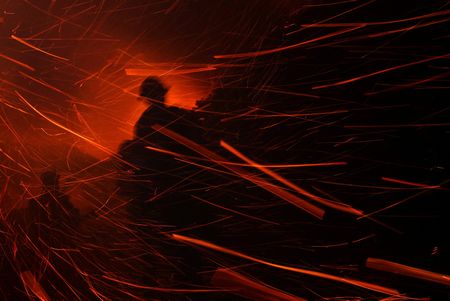
The year began with the most destructive wildfires in the history of Los Angeles. Fanned by high winds, flames swept through homes and businesses in the Palisades and in Pasadena, turning entire neighborhoods to ash.
These three photos were all taken within one mile of Anzuoni’s own home in Pasadena. His local McDonald’s is burning. Houses are gutted. At times, the photographer could hardly see.
“There were brief moments when the wind paused – as if gathering power – before slamming back with embers, smoke, and a deafening roar,” he said.
The experience still haunts Anzuoni.
“My home ultimately survived the fire, but so many others weren’t as fortunate – and that stays with me to this day.”
Rio police raids
Ricardo Moraes: Rio de Janeiro, Brazil
In drone images by photographer Ricardo Moraes, at first it may not be obvious what viewers are looking at. They see roofs, a busy street, and something running down the middle of the road.
Then it becomes clear that those are dozens of dead bodies, some covered in sheets and some exposed, half-dressed. They are not in a war zone or a muddy mass grave but on a commercial street, surrounded by crowds and cars and power lines. The juxtaposition between what looks like battlefield carnage and the bustling urban scene is jarring.
Moraes’ photographs were taken in October in a favela, the poor, informal settlements that are laced through the hilly landscape of Rio de Janeiro.
They show the grim aftermath of the deadliest police operation in Brazil’s history – one that left 121 people dead, including four police officers.
“I don’t like using a drone most of the time. Often you lose feeling and immediacy,” Moraes said. “But this time was the opposite. There was no better way to show what had happened.”
None of the 117 suspects killed were among the 69 named by prosecutors in the complaint providing the basis for the raid, Reuters reporting later established. Rio authorities have said it was difficult to look for specific people and that those killed were all criminals.
Kenya protests
Thomas Mukoya: Nairobi, Kenya
The scene is a main street – peaceful and free of people and traffic. But in the foreground the observer sees a single police riot shield, propped up by a baton. It is both a quiet moment and a portent of a day to come that will be far from quiet.
Thomas Mukoya took the photo in July ahead of “Saba Saba” protests to mark the 35th anniversary of Kenyan pro-democracy rallies. He was walking around downtown Nairobi and saw this opportunity on a road leading to the central business district.
“It is a rare photo without riot police officers or protesters, but strongly capturing the chilly, rainy day before anti-government protests,” he said.
“Sometimes good opportunities come from areas we do not expect and this could be for a split second.”
Police had blocked major roads into Nairobi and restricted traffic within the city, leaving streets deserted except for the demonstrators, who arrived on foot.
Eleven people were killed in clashes between police and demonstrators during the protests that took place later that day across Kenya. The annual protests were given fresh impetus in 2025 after the death of a blogger in police custody.
Banksy protest
Toby Melville: London, Britain
Banksy is one of Britain’s most famous artists. But Banksy’s true identity has never been confirmed, no one knows where or when the next work will pop up or what it will be, and its nature – appearing on walls and in public spaces – makes it ephemeral. That makes it really challenging for photographers to cover.
“It is a race to shoot editorial pictures and video with a new Banksy, either because it will be removed by the building owners or by people looking to try and take the work off a building to sell the highly valuable piece,” said photographer Toby Melville.
In this case, a mural appeared at London’s Royal Courts of Justice on a Sunday morning in September that depicted a judge beating a protester, a possible reaction to the arrest the previous day of almost 900 people at a demonstration in support of banned group Palestine Action.
Melville and colleagues saw a post on Banksy’s official Instagram, identified the location, and rushed there to photograph and video the work. Not a moment too soon. That same day, the mural was removed entirely from the Grade One-listed building – one with a high level of historical significance and protection.
Dirty water
Dylan Martinez: London, Britain
Photographer Dylan Martinez, a keen swimmer, spent years traveling around Britain to capture the story of the country’s broken sewage system.
“I became obsessed with trying to find the source of the untreated sewage polluting our water,” he said. “I met cold-water swimmers, activists, surfers, fish farmers, dog walkers and campaigners who were all trying to put a spotlight on this story.”
Because water pollution can be difficult to document visually, Martinez came up with an innovative response. He used an analogue film camera, and took water from sites of sewage discharge to mix with film developer and fixer when developing the images.
“The wonderful thing about film is that you never quite know, you’re never quite sure what it is (until it is developed) and that made me think of this problem of sewage and pollution. You’re never quite sure.”
In some cases, photos were scratched with grit, some were discolored, and some looked fine.
“The idea of not knowing how it would affect the film really seemed to get to the heart of the problem,” said Martinez. “What is this pollution really doing to our rivers and waterways?”
Pool alligator
Lisi Niesner: Elmenhorst, Germany
‘Pet alligator joins her human family in the pool’ was a popular Reuters visual story in 2025. Photographer Lisi Niesner took shots in August of the arrangement that would be highly unusual for most of us – but perfectly normal for the Kaulis family in northern Germany.
The family are former circus performers, and Krystian Kaulis described growing up with the alligator, known as Mrs Meyer. To Kaulis, Mrs Meyer is like a big sister, he said. As a kid, he did his school exercises next to her and played with her.
When their time with the circus ended, the family could not bear to give Mrs Meyer to a zoo. So they kept her, living in a pool at their house.
Niesner described watching Kaulis swim with the 45-year-old American alligator.
“In the beginning, it seemed they kept a little distance to respect each other’s space. And then there was a short moment when Krystian approached Mrs Meyer and gently caressed her long nose and her forehead atop the eyes and she reacted. The alligator moved very close to his neck as if she wanted to cuddle him.”
World Aquatics Championships
Marko Djurica, Claudia Greco, Edgar Su, Hollie Adams and Tingshu Wang: Singapore
Covering water sports can give photographers a chance to innovate to create experimental and almost fantastical frames. That was shown to brilliant effect in July at the World Aquatics Championships in Singapore.
Team leader Marko Djurica shot the men’s 27-meter high-diving semifinal from inside the pool, a first for Reuters. Wearing a wetsuit for nearly four hours, he captured a frame of diver Jean-David Duval when water splashed on his camera – a Canon R3 with underwater housing – at the perfect time.
With Claudia Greco, he also photographed artistic swimmers, using a camera in underwater housing operated by a laptop on dry land. It allows us to see under the surface – the moments before the show.
Edgar Su, meanwhile, seeking an original framing, took photos of the high diving from a public garden outside the venue.
“After trying various angles, I found a glass sculpture that was reflecting a spot of sunlight, creating a flare in the image,” he said. Seeing him placing a long lens close to the sculpture, members of the public visiting the garden wondered what he was doing – and then tried to repeat the effect with their mobile phones.
Hollie Adams snapped the fleeting moment a swimmer’s head pops out of the water, as if in a bubble, while Tingshu Wang listened to the music to capture Spanish artistic swimmers at just the right second.
World Athletics Championships
Pawel Kopczynski: Tokyo, Japan
Pawel Kopczynski has photographed pole vault competitions before, but for the World Athletics Championships in September in Tokyo he wanted to try something new.
He mounted a special camera directly on top of the pole and operated it remotely. That allowed him to get up close and personal with record-breaking Swedish pole vaulter Armand Duplantis.
“It captured the grace and power that define him, the space between his body and the bar emphasizing his precision,” said Kopczynski.
Getting the perfect shot was a feat Duplantis himself might appreciate. It involved months of preparation, securing permission to install the gear safely in the unusual location. It employed new technology with improved image quality. And of course, timing was key.
The final result proves how technology and planning can open new creative possibilities, said Kopczynski.
“It’s a reminder of how innovation keeps photojournalism evolving and how a single frame can redefine how we see sport.”
World Humanoid Robot Games
Tingshu Wang: Beijing, China
In August, Beijing held the first ever World Humanoid Robot Games. Robots from 16 countries competed in sports including track and field, table tennis, and martial arts, as well as practical challenges such as cleaning or sorting medicines.
It was, says photographer Tingshu Wang, a surreal sight. A seasoned athletics photographer, she began taking images for the games at the field level to try to humanize the robots, as she would with human competitors.
“But soon enough I realized that doesn’t work,” said Wang. “Robots have no emotions, and many of them don’t even have a face. They’re not competing. They’re programmed to repeat their motion, clumsily, repetitively and tirelessly, and many times ending in a fall or crash.”
She realized that the appeal was the relation between the robots and the human engineers, and from an elevated position she took this shot of a Unitree robot competing in the 400-metre race alongside its engineer. It ran more steadily and faster than many of the other robots, said Wang.
“Crowds cheered for it as it ran by,” she said. “It didn’t have much competition, and it doesn’t care.”
Hurricane Melissa
Raquel Cunha: Auchindown, Jamaica
Amid downed trees, the scattered debris of a home and bags of belongings, 13-year-old Andrieneke Hyman is gazing at her wet school notebook, its contents now blurred.
This picture, a perfect example of how photographers can show the way in which disaster events whose scale can be hard to comprehend affect people’s lives, was taken in November in Auchindown, Jamaica, following Hurricane Melissa. The hurricane had torn through the Caribbean, leaving death and destruction.
Photographer Raquel Cunha, traveling through one of the most affected regions, met a family sitting in front of the ruins of their house. She spoke to Andrieneke, who told Cunha how her notebooks had been soaked.
“As we talked, she told me what she had been learning before classes were suspended because of the storm,” said Cunha. Andrieneke said her dream was to become a pediatrician.
“When I realized she felt comfortable sharing what she was learning and the subjects she enjoyed most at school, I stepped back a little to capture a moment that reflected her interest in education. It was a simple, everyday gesture like flipping through a notebook, amid the devastation.”
“Hurricane Melissa passed through the country in just a few hours, but the destruction could affect generations.”
Pope Francis’ funeral
Yesim Dikmen: Vatican City
Yesim Dikmen is a senior visuals producer, charged with one of the biggest jobs in journalism in 2025: helping coordinate coverage of the April funeral of Pope Francis.
Sixteen Reuters photographers, some inside St. Peter’s Basilica, others perched on podiums or embedded in the crowd outside, shot the key moments and conveyed the sheer scale of the event. They captured the solemnity as the pallbearers raised the pope’s simple coffin and bore it past the mourners, some of them hoping to catch a glimpse and some deep in prayer.
The planning began almost two years earlier, said Dikmen.
“You get one chance to photograph a moment that will outlive you, so you make sure the right people are in the right places long before it arrives,” she said.
The team was built around the story’s needs, she added – “veteran photographers who knew every corner of St. Peter’s Square and younger ones who still felt the weight and wonder of the bells.”
They came from different countries and different disciplines, each contributing fresh ideas and perspectives.
“We didn’t just cover a funeral. We tried to document a turning point, precise, emotional, unmistakably human, and told the beginning of a papacy that has been witnessed 265 times before, in a way that felt new: modern tools, steady discipline, sharp instincts, and pictures that breathe.”
Partial solar eclipse
Borja Suarez: Castillo del Romeral, Spain
Celestial events like transits and eclipses are fun to watch from backyards, but for photographers they can also be great opportunities to experiment with new techniques.
Borja Suarez, who has a passion for astrophotography, took advantage of March’s partial solar eclipse – when the moon partially blocks out the sun – to try a multiple exposure and create a composite image.
“In the days leading up to the event, I planned the image by doing tests to determine how many photos of the sun would fit in the final composition — which turned out to be seven — as well as calculating how often to take each shot,” said Suarez.
He also needed a high-capacity battery that would keep his camera going for the entire 1.5 hours plus of the eclipse – and (just like Gaby Oraa) a bit of luck. Cloud cover at any point would ruin the effect. Photographing the sun also needs to be done with care and the use of a filter to avoid harming eyes or equipment.
In the end, Suarez’s planning paid off, the clouds stayed away, and he was rewarded with this image, where the sun is turned into a string of pearls and the progression of the moon taking a nibble out of our system’s star can clearly be seen.
(Writing by Rosalba O’Brien; Editing by Daniel Wallis)
Brought to you by www.srnnews.com
 Gaza families struggle to recover from days of torrential rains that killed 12 people
 EU moves to ease 2035 ban on internal combustion cars as auto industry faces headwinds
 Prosecutors weigh charges for son of slain filmmaker Rob Reiner