
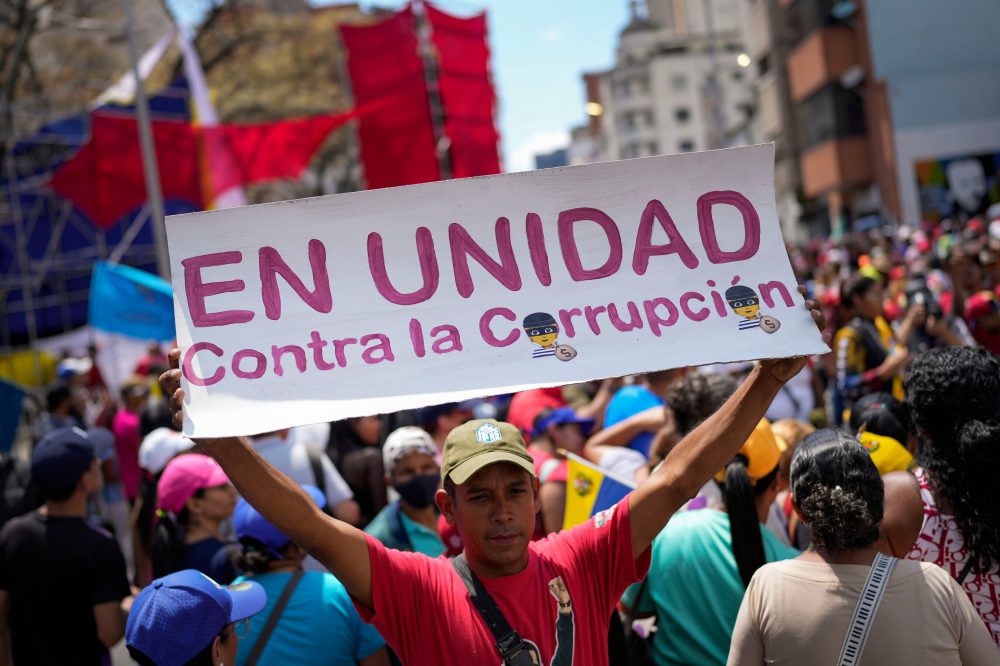
BERLIN (AP) — Established democracies’ efforts against public-sector corruption appear to be flagging, according to a survey released Tuesday that serves as a barometer of perceived corruption worldwide. It raised concern about developments in the United States and the impact elsewhere of U.S. funding cuts.
Transparency International’s Corruption Perceptions Index for 2025 gave top place to Denmark, with 89 points out of 100, followed by Finland and Singapore. At the bottom were South Sudan and Somalia with nine points apiece, followed by Venezuela. The leading trio was unchanged, and the last three only in that South Sudan gained a point to draw level with Somalia.
The group said most countries are failing to keep corruption under control, with 122 out of the 182 nations and territories surveyed scoring less than 50 points. The global average last year was 42, down one point to the lowest in over a decade. Only five countries scored above 80 in the 2025 report, down from 12 a decade ago.
The report lamented that “too often, we are seeing a failure of good governance and accountable leadership.”
It also pointed to “a worrying trend of democracies seeing worsening perceived corruption.”
Among those, it pointed even to high-scoring New Zealand, down two points at 81, and Sweden, unchanged on 80; as well as Canada, the United Kingdom, France and the United States, which scored 75, 70, 66 and 64 points respectively.
The U.S. was down one point from 2024 for its worst showing yet under the methodology Transparency started using for its global ranking in 2012, putting it in 29th place in the first year of President Donald Trump’s second term.
“While the data has yet to fully reflect developments in 2025, the use of public office to target and restrict independent voices such as NGOs and journalists, the normalization of conflicted and transactional politics, the politicization of prosecutorial decision making, and actions that undermine judicial independence, among many others, all send a dangerous signal that corrupt practices are acceptable,” the report said.
Transparency International also argued that the U.S. decision “to temporarily freeze and then degrade enforcement of its Foreign Corrupt Practices Act … sends a dangerous signal that bribery and other corrupt practices are acceptable.”
Trump said a year ago, when he froze enforcement of the 1977 law that prohibits people or companies operating in the U.S. from giving money or gifts to foreign officials to win or retain deals in those countries, that “it sounds good on paper but in practicality, it’s a disaster.” To its detractors, the act has unfairly hobbled American companies while foreign rivals swoop in.
Separately, Transparency said that “U.S. aid cuts to funding for overseas civil society groups that scrutinize their governments has undermined anti-corruption efforts around the world.” It contended that “political leaders in various countries have also taken this as a cue to further target and restrict independent voices, such as NGOs and journalists.”
The organization measures experts’ perception of public-sector corruption around the world according to 13 data sources, including the World Bank, the World Economic Forum and private risk and consulting companies.
Fifty countries’ scores have declined significantly since 2012, it said — with Hungary, now on 40 points; Turkey, on 31; and Nicaragua, on 14, among the biggest fallers.
At the same time, it said 31 countries have improved significantly, highlighting Estonia (76 points), the Seychelles (68) and South Korea (63).
Russia remained close to the bottom of the index with an unchanged score of 22, with Transparency International citing “fully centralized, opaque governance that suppresses media, civil society and political opposition.”
Nearly four years into Russia’s full-scale invasion, Ukraine was up one point at 36 after an energy-sector corruption scandal forced high-level resignations. Transparency said that civil-society mobilization protected key anti-corruption institutions and investigations were increased, though “further reforms are needed to protect defense and reconstruction funds from misuse.”
Brought to you by www.srnnews.com
 Macron warns of renewed US clashes as he urges EU to use ‘Greenland moment’ to push reforms
 Palestinians in the West Bank struggle to get by as Israel severely limits work permits
 Factbox-Main parties in Bangladesh election