
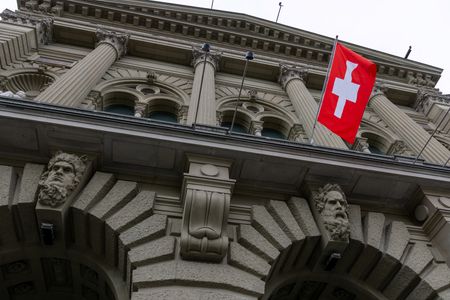
ZURICH, Jan 28 (Reuters) – Switzerland plans to inject an additional 31 billion Swiss francs ($40.4 billion) into defence and security spending starting from 2028 and will increase sales tax for a decade to fund it, the government said on Wednesday.
Citing a deterioration in the geopolitical situation, the governing Federal Council said defence must be strengthened in Switzerland, where spending on the military is not currently scheduled to reach 1% of gross domestic product until 2032.
“The world has become more volatile and insecure, and the international order based on international law is under strain,” the government said, noting various European countries have been strengthening their defence capabilities.
Under the new plan, sales tax is to be increased by 0.8 percentage points for 10 years starting in 2028, it said.
‘CRITICAL GAPS’ IN CAPABILITIES
Switzerland will reprioritise short-term procurement to face the most probable threats, Defence Minister Martin Pfister said, citing the need to counter mini-drones, invest in IT, and enhance cyber protection and electromagnetic reconnaissance.
“There are critical gaps in our capabilities,” Pfister told a press conference in which officials said spending would also bolster police and border protection, Switzerland’s ability to tackle long-distance threats and hybrid attacks.
Swiss officials and lawmakers warn that conflicts including Russia’s invasion of Ukraine, U.S. rivalry with China and Middle East tensions pose growing risks to the country through spying, cyberattacks and even terrorist attacks.
The government said current financial planning no longer reflected increases in the cost of arms, which have been driven by inflation and greater demand.
The higher outlays should raise spending on defence to around 1.3% to 1.5% of Swiss gross domestic product, said Marc Siegenthaler, a senior defence ministry official.
The government’s plan will need to pass parliament and faces a referendum that could take place next year, it said.
Separately, the government said it wanted to overhaul intelligence service legislation to boost its ability to detect threats from terrorism, extremism, espionage and cyberattacks.
Under the reform, the mandate of the Federal Intelligence Service would be expanded, enabling it to collect data from banks and other financial service providers to address serious threats such as terrorist financing or spying.
($1 = 0.7678 Swiss francs)
(Reporting by Dave GrahamEditing by Miranda Murray and Gareth Jones)
Brought to you by www.srnnews.com
 The Media Line: Islamabad Court Sentences Human Rights Lawyer, Husband to 17 Years Over Social Media Posts Under PECA
 What to know about Gaza’s Rafah crossing, which could open within days