
By Suleiman Al-Khalidi, Mahmoud Hasano , Jonathan Spicer and Timour Azhari
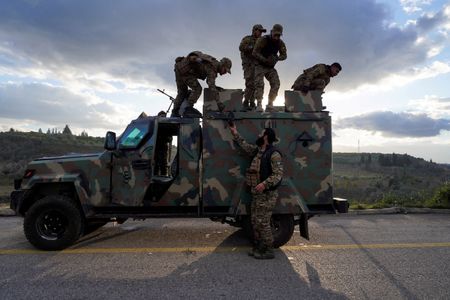
Jan 15 (Reuters) – Syrian troops are poised to attack towns in the north and east held by Kurdish fighters, sources familiar with the matter said, to pressure autonomy-minded Kurds into making concessions in deadlocked talks with the Damascus government.
The threat of renewed military action highlights the deepening fault lines between the government of President Ahmed al-Sharaa, who has vowed to reunify the fractured country under one leadership after 14 years of civil war, and regional Kurdish authorities wary of his Islamist-led administration.
The United States, which seeks to anchor peace in Syria to shore up wider Middle East stability and help prevent any resurgence of Islamic State militants, has urged both sides to avoid a showdown and return to talks, according to a Syrian official and a Syrian source familiar with diplomatic channels.
The two sides engaged in months of talks last year to integrate Kurdish-run military and civilian bodies into Syrian state institutions by the end of 2025, insisting repeatedly that they wanted to resolve disputes diplomatically.
But after the deadline passed with little progress, clashes broke out last week in the northern city of Aleppo and ended with a withdrawal of Kurdish fighters.
Now, a broader confrontation looms, according to the sources, who include three Syrian officials, two Kurdish figures and three foreign diplomats.
As many as five Syrian army divisions could take part in the offensive targeting Kurdish-held towns in the northern province of Aleppo and the vast eastern desert province of Deir el-Zor, a senior military official involved in the planning told Reuters.
If the tactic fails to bring the parties back to the negotiating table, Syria’s army is considering a full-scale campaign that could see the Kurds lose the semi-autonomous zone they have managed for more than a decade, the official said.
ESCALATION BRINGS ‘GRAVE RISKS’
Syrian army units deployed on Wednesday and Thursday to the town of Deir Hafer and surrounding villages just west of the Euphrates River held by the Syrian Democratic Forces, the main Kurdish fighting force and a years-long recipient of U.S. support as it battled the Islamic State militant group.
Syria’s military has ordered SDF fighters to withdraw east of the river and opened a humanitarian corridor for civilians to flee to government-held territory.
Some residents who made it out told Reuters they had to flee through farmland on foot as the main road had been shut. The SDF denied that it had blocked civilians from leaving.
Other Syrian troops were quietly sent to another front line in remote Deir el-Zor province, where the Kurds run key oil fields that Damascus says should be under central state control, according to two Syrian army commanders.
The SDF has condemned the build-up. “We clearly state that we are against any military confrontation, given its grave risks,” Abdel Karim Omar, the Damascus-based representative of the Kurdish-led administration, told Reuters.
He said efforts were underway with the help of foreign mediators to revive the negotiations.
Washington had not explicitly opposed a limited operation by Syrian troops, three diplomats and an SDF official, who spoke on condition of anonymity, told Reuters. But the SDF official said the U.S. was not doing enough to prevent a clash.
U.S. envoy Tom Barrack said on Friday Washington was in “close contact with all parties in Syria, working around the clock to lower the temperature, prevent escalation, and return to integration talks between the Syrian government and the SDF”.
A State Department spokesperson said both sides should avoid “pushing the country back into a cycle of violence”.
The messaging underscores Washington’s effort to recalibrate its Syria policy by balancing years of backing for the SDF against its new support for Sharaa, whose rebel forces ousted Russian-backed Syrian dictator Bashar al-Assad in late 2024.
Sharaa accused the SDF of obstructing U.S. policy to nurture a reintegrated Syria and taking orders from the Kurdistan Workers’ Party, a separatist group that waged a long insurgency in Turkey before entering into a peace process with Ankara.
Sharaa, speaking on state TV, said the SDF had taken “no practical steps forward” to implement last year’s integration pact, but hoped it could still be carried out “calmly.”
TRIBES AWAIT GOVERNMENT ORDERS
Turkish Foreign Minister Hakan Fidan said the SDF must show good intentions by unilaterally leaving the Deir Hafer area, instead of being expelled by a military offensive.
“I hope it doesn’t come to that point …, but when problems are not solved through dialogue, unfortunately, I see from here that the use of force is also an option for the Syrian government,” Fidan said on Thursday.
If fighting spills into Deir el-Zor, it could draw in local Arab tribes who complain of marginalisation and forced conscription of tribesmen into the SDF, according to the Syrian military officials and two tribal leaders.
Shayesh al-Mulhem, a leader of the Jabbour tribe, said it was awaiting orders from Sharaa to turn against the SDF.
“The SDF is doomed to disappear. There can’t be a state within a state, and there can’t be a faction on Syrian land that is against the state,” he said.
(Additional reporting by Khalil Ashawi in Damascus, Tuvan Gumrukcu in Ankara and Maya Gebeily in Beirut; writing by Maya Gebeily; editing by Mark Heinrich)
Brought to you by www.srnnews.com
 Tears and anger in Europe as exiled Iranians protest government crackdown
 Five pro-Palestinian activists plead not guilty over UK military base break-in
 Czechs set to provide Ukraine with drone-fighting jets, president says
 Greece plans extension of territorial waters despite Turkish warning