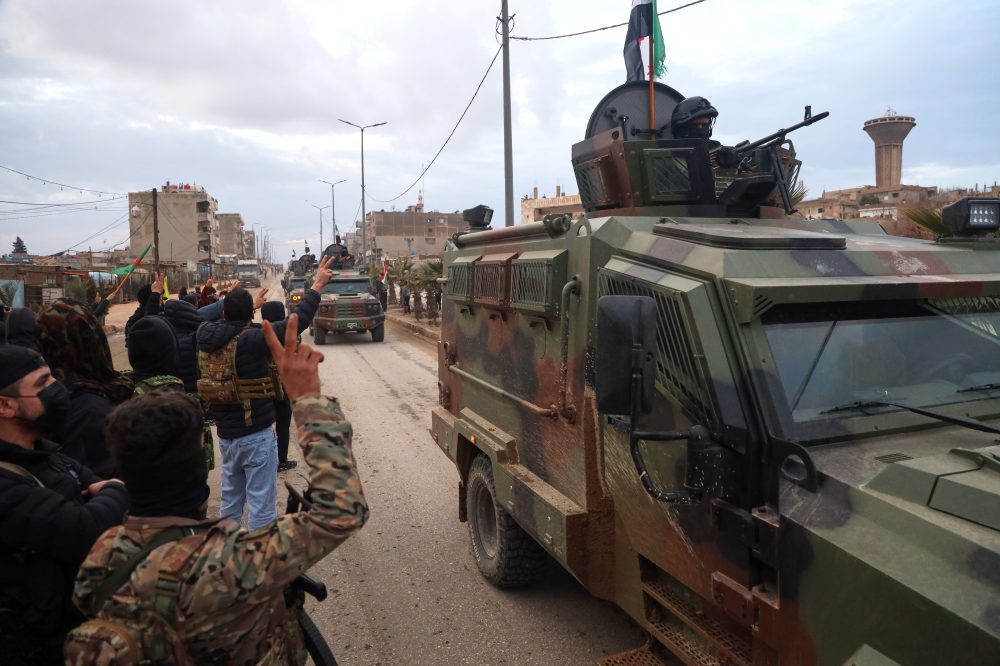
QAMISHLI, Syria (AP) — Security forces affiliated with Syria’s Interior Ministry continued Tuesday to deploy in Kurdish-dominated areas in northeastern Syria as part of an agreement between Damascus and the Kurdish-led Syrian Democratic Forces.
A convoy of security forces entered the Kurdish-majority city of Qamishli, in the countryside of al-Hasakah province — where they entered on Monday.
Under the deal, small contingents of security forces reporting to the Interior Ministry will enter Kurdish-majority areas. Their mandate is limited to securing state-affiliated institutions, including civil registry offices, passport departments and the airport, and to restart work at those facilities.
Security was visibly tightened on Amuda Street, the main road leading into Qamishli, ahead of the deployment. Streets were largely empty since the SDF imposed a curfew, with shops shuttered and heavily armed SDF personnel and local Kurdish security forces spread across major roads and intersections.
Some fighters had their faces covered, and several women were among the forces deployed. Yellow flags of the Kurdish People’s Protection Units were seen alongside Kurdish flags lining closed storefronts.
“We are coordinating with the other side inside Qamishli for our forces to deploy inside the city,” said the spokesperson for the Syrian Interior Ministry, Nour al-Din al-Baba.
“There is a program and a time frame to finalize all of the deal’s clauses, among them is taking over the vital facilities, including the crossings, the Qamishli airport and oil facilities, managing them and making them operational in the service of the Syrian people,” he added.
Samer Ahmad, a member of the local Kurdish security forces, told the AP that Kurdish forces remain in control of security in the city as he held his rifle and monitored the situation in Qamishli.
“All necessary measures have been taken, and our forces are ready to confront sleeper cells and those seeking to carry out acts of sabotage,” Ahmad said.
“The incoming (government) forces will be deployed at four points in the city of Qamishli, and their presence here will be temporary. God willing, in the coming period, once integration is completed, they will withdraw,” he added.
Before arriving in Qamishli, convoys of security force vehicles bearing Syrian flags entered Tell Brak, east of Hasakah — a focal area between Qamishli and Hasakah — as crowds lined the roads, waving Syrian flags and cheering their arrival. People chanted through megaphones, “The Syrian people are one.”
Some men fired celebratory gunfire into the air while women ululated.
“We hope that the Arab Syrian army becomes the one in control, and we hope this happiness is spread across Syria, north to south to east to west,” said Adel al-Ahmad, who was among those welcoming the convoy.
He expressed contentment over what he described as “the liberation of Al-Hasakah from the SDF as well as Qamishli, where the SDF is still present, in addition to Al-Jawaliyeh and Kahtaniyeh and Al-Malikiyah.”
Arab residents in SDF‑controlled areas have long complained of political and economic marginalization, while many Kurdish communities fear reprisals from government‑affiliated fighters — concerns sharpened by the widespread sectarian killings and retaliatory attacks that erupted across Syria in 2025, especially in coastal and southern regions.
“We are happy with the entry of the internal security to Al-Hasakeh on the way to Qamishli,” said Wissam al-Motlak, another spectator.
___
Find more of AP’s Middle East coverage at https://apnews.com/hub/middle-east
Brought to you by www.srnnews.com
 Collision between migrant speedboat, Greek coast guard vessel leaves at least 14 dead
 Trump says US working on sanctions with Colombia, calls meeting with Petro ‘very good’
 Seif al-Islam Gadhafi, son of Libya’s late dictator, killed in north Africa country, officials say