
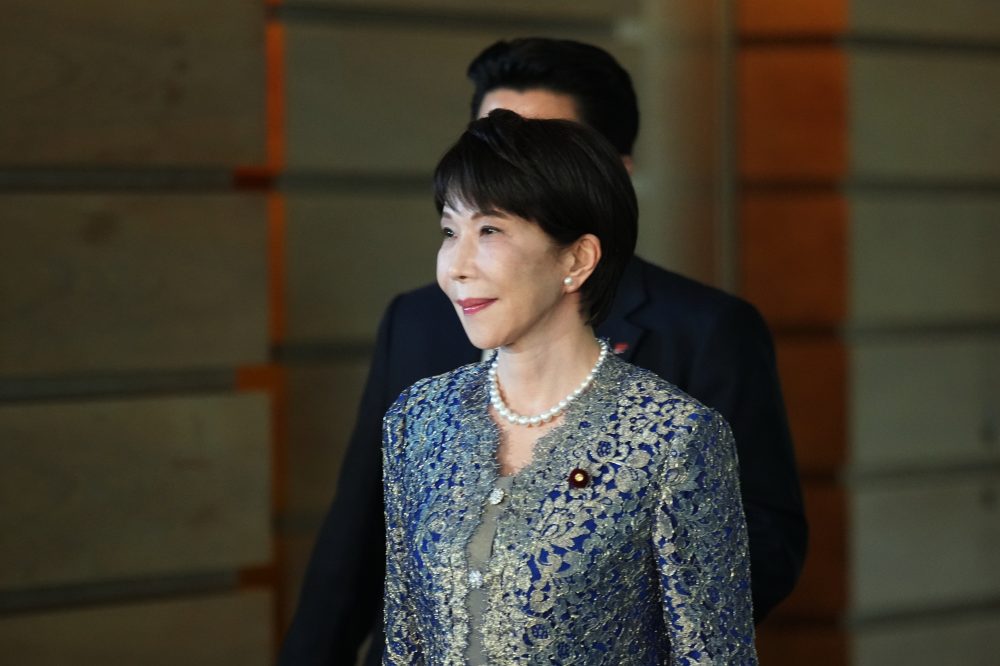
TOKYO (AP) — Japan’s Prime Minister Sanae Takaichi reshuffled her Cabinet on Thursday in a bid to turn around her waning popularity, but retained key ministers as she pursues stronger ties with the U.S.
Japan faces President Donald Trump ‘s tough demands for bigger defense spending, more investment in America and measures to combat a weak yen.
The reshuffle is the first by the right-wing star of the governing Liberal Democratic Party since she took office last October as Japan’s first female leader in modern history. It’s a widely used tactic by a prime minister to manage power balance within the party, policy priorities and public opinion.
She had for months enjoyed high ratings, attracting young voters with her style and straight talk that were fresh in male-dominated Japanese politics. But she has seen her popularity fade after pushing policies including an enforcement of male-only succession rules for the i mperial family at a time people were expecting tougher measures to fight inflation.
Takaichi retained Defense Minister Shinjiro Koizumi and Foreign Minister Toshimitsu Motegi to ensure continuity of Japan’s key policies and good ties with Washington. Both are Takaichi’s main party rivals and keeping them is seen as her strategy to contain their influence.
Takaichi also kept Finance Minister Satsuki Katayama, her longtime confidant who has been implementing her ambitious spending policy, and Economy and Fiscal Policy Minister Minoru Kiuchi. Trade Minister Ryosei Akazawa, who has dealt with Trump’s tariff and investment demands, also kept his job.
In a party leadership revamp Wednesday, Takaichi retained a kingmaker and former Prime Minister Taro Aso as LDP vice president, his brother-in-law Shunichi Suzuki as secretary-general and a few of her right-wing allies. Her rival Takayuki Kobayashi stayed on as head of the LDP policy research council.
Maintaining stable ties with Washington is also important for Takaichi as Japan struggles to mend ties with China following her comment last year that Japan’s military would could intervene if China were to take action against Taiwan — an island democracy that Beijing considers its own territory. The tensions have spilled over into the neighbors’ economic ties.
Takaichi, who will attend the U.N. General Assembly in New York later this month, is seeking a meeting with Trump ahead of his planned Sept. 24 talks with Chinese President Xi Jinping, but prospects are unclear, according to Japanese media reports.
Takaichi’s government is working to revise security and defense strategy documents by the end of the year to bolster Japan’s offensive capabilities to deter threats from China, North Korea and Russia. Japan says it wants to adapt to “new ways of warfare” that involves use of artificial intelligence and combat drones and their deployment.
Takaichi-led government has increased defense spending to 2% of gross domestic product and wants spend more for 2027. Japan is likely to face U.S. demand for further increase, possibly up to 3.5% of GDP.
The victory in the Okinawa gubernatorial election Sunday by Genta Koja, a conservative new face backed by Takaichi’s LDP and several other conservative parties, is expected to help her push for a military buildup on Japan’s southern islands to deter China.
Takaichi replaced 10 out of 18 ministers. Hiroshi Nakatsuka, from the LDP’s junior coalition partner Japan Innovation Party, was appointed as minister of administrative reform and children policies. Kazuo Yana replaced Norikazu Suzuki as agriculture minister, despite Yana’s alleged involvement in a political funds scandal. Internal Affairs Mnister Yoshimasa Hayashi, Takaichi’s party rival, was replaced by Hisayuki Fujii.
Takaichi, as part of her measures to combat rising prices, has pushed a two-year cut in the consumption tax to 1% from the current 8% and payouts to households. But the plan without funding details has divided her party and could be a problem when parliament reconvenes in October.
The tax measure, adopted Monday by the Cabinet, has added to concern about Japan’s already strained financial health. Takaichi’s spending policy has already prompted U.S. Treasury Secretary Scott Bessent to urge Japan to stop the reflationary policy of weak yen and low interest rates.
Brought to you by www.srnnews.com
 The king and AI: UK monarch Charles meets with artificial intelligence leaders
 Russian barrage of missiles and drones on Ukraine injures at least 19, including children
 South Korea set to approve abortion pills next year
 Buckingham Palace hits back at claims in a book by Princess Diana’s brother