
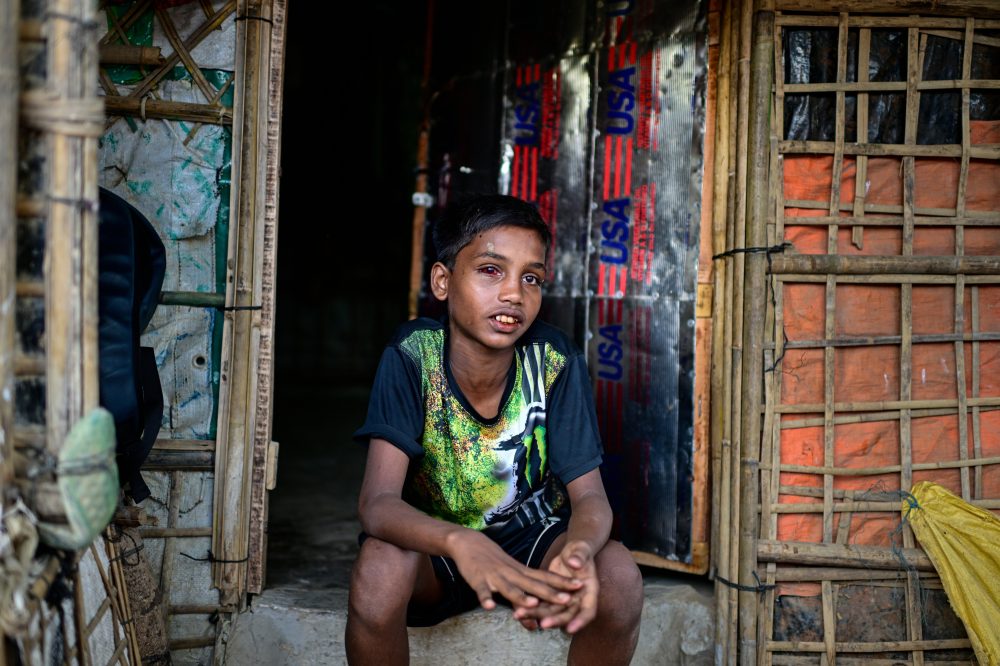
UKHIYA, Bangladesh (AP) — The United States’ decision to slash its foreign aid program has contributed to a sharp rise in abuses involving children trapped in Bangladesh’s refugee camps for members of Myanmar’s persecuted Rohingya minority, The Associated Press found.
In interviews with 37 children, family members, teachers, community leaders and aid workers, the AP has documented an increase in child marriage, child labor, kidnapping and other violations against children since U.S. President Donald Trump’s decision in January to dismantle the U.S. Agency for International Development.
Here’s a closer look at AP’s report on the fallout from the aid cuts:
More than half of the 1.2 million Rohingya languishing in these camps are children. Bangladesh bars the Rohingya from working, and they are unable to safely return to their homeland of Myanmar, which is controlled by the same military that killed thousands of Rohingya in 2017 in what the U.S. dubbed a genocide. That has left them dependent upon humanitarian aid to survive.
The U.S. has long been the biggest provider of humanitarian funding to the Rohingya. But in January, Trump dubbed USAID wasteful and shut it down, despite the U.S. spending just 1% of its budget on foreign aid. The move has proven catastrophic for the world’s most vulnerable. In Myanmar, the AP found the aid cuts have caused children to starve to death, despite U.S. Secretary of State Marco Rubio’s statement to Congress that “No one has died” because of the dissolution of USAID.
In the Bangladesh camps, Trump’s decision meant the U.S. contribution for 2025 was slashed nearly in half compared to last year. The overall Rohingya emergency response is only 50% funded for the year, and aid agencies say next year is expected to be far worse.
UNICEF, the United Nations’ children’s agency, lost 27% of its funding due to the U.S. aid cuts and subsequently shuttered 2,800 of its schools in June.
The U.S. cuts, along with funding reductions from other countries, also crippled child protection programs, along with healthcare, nutrition and sanitation services.
The school closures had a devastating impact on children. With their learning opportunities gone, hundreds of underage girls were forced into unwanted marriages, many of which quickly turned abusive. Scores of children as young as 10 were forced into manual labor. With no safe space to play or learn, children were left to wander the labyrinthine camps, making them increasingly easy targets for kidnappers, traffickers and armed militant groups.
Between January and mid-November, reported cases of abduction and kidnapping more than quadrupled over the same time period last year, to 560 children, according to UNICEF. And there has been an eightfold increase in reports of recruitment and use of children for training and support roles in the camps by armed groups, with 817 children affected. The actual number of cases is likely higher due to underreporting, the agency said.
Verified cases of child marriage, which the U.N. defines as the union of children under age 18, rose by 21% and verified child labor cases by 17% in the year to September, compared to the same time period last year. Those statistics are likely to be a significant undercount, says Patrick Halton, a child protection manager for UNICEF.
“With the funding cuts, we had to downscale a lot in terms of the education,” Halton says. “It’s meant that children have not necessarily had things to do, and we’ve therefore seen this rise in children being married, children being in child labor.”
In a statement to the AP, the State Department said the U.S. has provided more than $168 million to the Rohingya since the beginning of Trump’s term, although data from the U.N.’s financial tracking service show the U.S. contribution in 2025 is $156 million.
The State Department said it had “advanced burden sharing and improved efficiency” in the Rohingya response, resulting in 11 countries increasing their funding by more than 10 percent year on year, collectively contributing $72 million.
“The Trump Administration continues to pursue the diplomatic efforts to encourage additional countries to help shoulder the burden,” the statement said.
The department did not respond to AP’s request for evidence that the U.S. had any influence on other countries’ funding decisions for the Rohingya response.
Hasina, who was 16 when she was married off after her school closed, is now trapped with a husband who she says beats and sexually abuses her. She daydreams daily of school, where she was a whiz at English and hoped to become a teacher. Now, she is confined largely to her shelter, cooking and cleaning and waiting with dread for the next beating. The AP is withholding her full name to protect her from retaliation by her husband.
“I dreamed of being something, of working for the community,” Hasina says softly. “My life is destroyed.”
—-
Contact AP’s global investigative team at Investigative@ap.org or https://www.ap.org/tips/.
Brought to you by www.srnnews.com
 What to know about a Philippines region with militant history visited by Bondi Beach suspects
 Japan visitor arrivals growth strong in November despite China travel warning
 Church altar featuring homeless man goes on display a stone’s throw from his grave at the Vatican