
By Sarah Kinosian
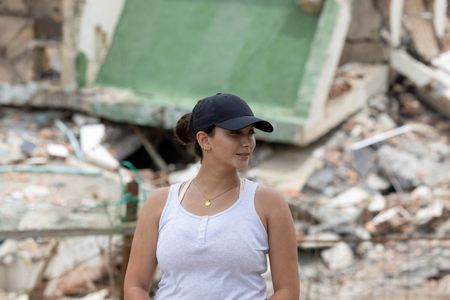
LA GUAIRA, Venezuela, July 11 (Reuters) – Maria Alejandra Sanz turned away when she heard rescue workers had pulled the lifeless body of one of her best friends from the rubble of a building leveled by twin earthquakes that struck the state of La Guaira in northern Venezuela last month.
The 17-year-old high school student had lain in near-darkness for 17 hours after the June 24 quakes, trapped beneath the collapsed building in the coastal town of La Guaira where she had grown up, drinking her own urine to survive and assuming the other members of her dance troupe were dead.
Of the group of 10 friends who had been preparing a routine for their high school graduation, four did not make it out alive.
“I’m fine,” Sanz said unconvincingly during an interview in front of her former home nine days after the disaster, the Caribbean air still heavy with dust and grief. Earlier that day, rescuers had pulled the body of her friend, Gonzalo Marquez, from the rubble.
Then came a string of unanswerable questions: Would her friends have survived if rescuers had arrived sooner? Would things be different if the dance troupe had practiced in a different building? What if she had been with Marquez downstairs instead of fetching him water from her upstairs apartment? Why does she get to go to university, while he is laid to rest?
Raised amid economic collapse, mass migration and authoritarian rule, Sanz and her friends began 2026 believing the U.S. ouster of Venezuelan President Nicolas Maduro might finally offer a different future.
Then came the quakes, which the government says have so far killed over 4,000 people and injured nearly 17,000 others.
SAVED BY A FRIEND’S THIRST
Sanz’s troupe had been practicing seven days a week in the month leading up to the quakes, sometimes going until 3 a.m. That evening, in the ground-floor party hall of her building, they had been refining moves to “Dangerous,” a 1991 song by U.S. pop icon Michael Jackson.
Graduation was in three days.
About 20 minutes before the quakes struck, Marquez asked Sanz for water. She went up to the third-floor apartment she shared with her parents, petted her dog Bruna for the last time and was about to reach the water when the building started to shake at 6:04 p.m.
She moved to the nearest door frame and seconds later was engulfed in darkness as the floors below her gave way. The door frame fell over her midsection diagonally, shielding her from a collapsed wall.
Sanz saw a sliver of light across her fingers and knew she was not buried too deep. She was able to free her feet by slipping out of the oversized sneakers she was given for the dance performance.
She says she knew her own urine might offer her only chance to drink, so she caught what she could in her hand and raised it to her mouth. The light soon faded and she prayed.
“If I have to die, let it be while I’m asleep,” she remembers thinking at the time.
Sanz woke to light falling across her hand again and began clawing toward it, wedging her body slowly between chunks of concrete and making a hole she could fit through in the wall above her.
When she emerged with half her body free, she yelled out to a neighbor for help. Sanz’s 71-year-old father, who had been outside along with his wife at the time of the quakes, sprinted up the pile of debris. The teen hung on to him in a mental fog. When she got to her mother, Sanz learned that five of her 10 friends had escaped unscathed.
“What about Gonzalo? Isa?” Sanz asked.
There was no news about Marquez, but volunteer rescue workers had seen Isa Campos, whom Sanz had known her whole life, conscious underneath the rubble. She was alive, they said.
At the time it was true.
‘THAT COULD BE MY DAUGHTER’
Jeffry Campos, the father of the trapped girl, had arrived at the scene within two hours of the disaster and spent all night plunging into the mass of concrete and steel with the father of another dancer. By 11 a.m., a Caracas police unit joined the effort, using only their bare hands.
The equipment they needed to pull Isa Campos from between two beams never arrived. Known for her intelligence and electric energy, she died some 24 hours after the quakes. Her body remains in the rubble.
“Help arrived late,” her father said outside a church where a mass was held in his daughter’s honor. “Rescue workers, firemen and the military did not arrive until two or three days later.”
After seeing a TikTok video about the trapped dancers the night of the quakes, civil engineer Andres Ganscka set out from his home in central Colombia with hydraulic and power jacks, hand tools, diapers and baby cream.
“I saw it and thought, ‘That could be my daughter,'” said Ganscka, a father of three.
He arrived the next night to a disaster site strewn with bodies and limbs. He coordinated volunteer rescue workers at the Sanz family’s building, scouring the rubble for the missing dancers and 15 other children who had been playing table tennis inside. Venezuelan authorities finally arrived three days after him. In total, Ganscka spent around $35,000 on the rescue effort.
AN IMAGINED FUTURE
Sanz and Marquez both had places at universities in Caracas; he planned to study engineering and she was focused on architecture. They talked about staying in Venezuela to build a better country.
Like other Venezuelans their age, they had watched their parents struggle through an economic crisis that has lasted more than a decade, political upheaval and outbreaks of violence while friends and relatives migrated abroad. But the capture of Maduro by U.S. forces during a raid in January seemed to offer hope.
When Marquez was assigned the desk next to hers during their freshman year, Sanz says she didn’t think much of him. But by senior year, they were inseparable friends. Though not outwardly funny in the beginning of their relationship, he would later constantly tease her with his sarcastic jokes. They were Mr. and Mrs. Claus at the school’s Christmas performance. When not dancing, they practiced piano.
“He was often the only boy, he didn’t care what anyone thought, full of personality and the protector of the crew,” Sanz said.
The once-active group chat in which they would coordinate costumes, set design and practice times has largely fallen silent. Sanz says the other survivors drift between numbness and grief, okay one moment and crying the next.
“We talked about how we weren’t going to see each other after graduation, we talked about how Gonzalo looked like his dad and would have gray hair,” Sanz said. “They’ll stay young forever, always young.”
(Reporting and writing by Sarah Kinosian in La Guaira, Venezuela; Editing by Paul Simao)
Brought to you by www.srnnews.com
 Hundreds of firefighters battle wildfire in southern Spain that killed at least 12
 11 wounded in overnight Russian missile and drone strikes on Kyiv; Ukraine attacks Russian vessels
 Spanish firefighters turn to the offensive against deadly Almeria blaze
 Iran’s Supreme Leader pledges revenge for slain father and predecessor