

Buffer Zones and Collapse Fears: Israeli and Lebanese Analysts Assess a War With No Clear Endgame
Military objectives on the ground collide with political fragility and deep uncertainty about what comes next
By Giorgia Valente / The Media Line
As Israeli ground forces advance into southern Lebanon and Hezbollah expands its fire across northern Israel, the conflict is unfolding in real time, with the past 36 hours bringing new uncertainty for civilians on both sides.
Across the border, two analysts describe a situation shaped not only by military maneuvers, but also by eroding trust, weak institutions, and a profound uncertainty about what comes next.
In Israel, Sarit Zehavi, founder and president of the Alma Center, framed the operation as a response to what she described as Hezbollah’s escalation.
“We don’t know where this is heading, but let’s just see what we had until now,” she said. “Hezbollah started the war against us almost 48 hours ago, launching drones and rockets against various places in Israel,” she told The Media Line.
Zehavi described the scope of the attacks as spanning multiple targets: “This means next to the border, it means in depth, into strategic sites in Israel, and it means against the communities over here in the north.”
Although most projectiles were intercepted, she acknowledged the impact: “Most of the weapons that Hezbollah launched were intercepted, but not all of it, causing some damages in different places.”
Near the northern border, she said, residents have almost no margin for reaction. “It means that the Israelis that are living up north, especially those who are living next to the border, have only 15 seconds to get to the bomb shelter.”
Unlike in 2023, communities were not evacuated, a choice she attributed to Hezbollah’s weakened posture. “The decision was not to evacuate the communities, as opposed to what happened in 2023 when we evacuated the communities next to the border. The reason is because Hezbollah is not at the same place as it used to be. It is much weaker.”
Even so, she acknowledged residual risks from Hezbollah’s forces, including the Radwan Brigades. “The Radwan Brigades are not at the same capability, the anti-tank missiles are not at the same capability, and yet there is understanding that if Hezbollah will decide to send squads here and there to reach to the border, some of them may cross.”
Asked about Israel’s stated objective on the ground, Zehavi said the goal is to deepen the buffer beyond limited positions. “IDF entered Lebanon in order to create a better buffer in not only the five hills that we are holding; five hills are not enough to create a buffer towards 20 communities that are located at the fence.”
She added: “You need much more presence of soldiers in those areas, and that way, you create a buffer that doesn’t enable Hezbollah to come nearby, to go down south and to launch anti-tank missiles from the borderline against anybody who is living here in Israel.”
In Lebanon, the picture is defined by uncertainty, limited state capacity, and public questioning.
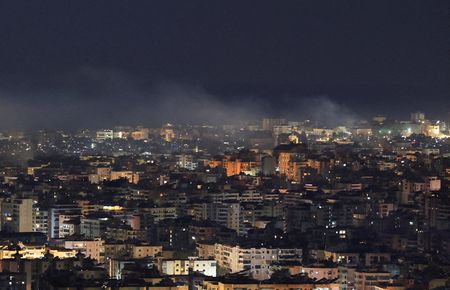
From Beirut, Azzam, a Lebanese political analyst, said strikes were taking place in real time. “One minute before you called me, there was a bombing here,” he told The Media Line.
He described doubts that have surfaced even within Hezbollah’s base. “So, of course, there’s a huge doubt about this step being done by Hezbollah, as in people are questioning themselves, why would you do this? It seems to be counterintuitive that they would win because of these acts. And therefore, there’s lots of questioning even among the Shia about the Hezbollah move,” he said.
Waiting for clarity, he added, “We’re just bracing ourselves to see what happens. Everything happened so fast.”
Linking Lebanon’s trajectory to developments in Iran, he said: “I would assume that if Iran, if the regime in Iran actually falls, then Lebanon would be a detail and a footnote to whatever happens there. But if not, then we will have to wait and see how this unfolds in Lebanon. But I don’t think it’ll be easy.”
Civilian protection, Azzam suggested, looks very different on the two sides of the border.
In Israel, residents have seconds to reach shelters. In Lebanon, he said, there are none. “No, there are no bunkers at all and no ways to intercept any threats like other Arab countries.”
Instead, civilians navigate what they believe are safer areas. “There are areas where it’s likely that there is some Hezbollah facilities or personnel. There are areas where it’s highly unlikely they will strike. And therefore, you get safer areas,” he said.
Movement itself is uncertain. “But this also depends on, are people able to move? Do they have someplace else to stay? What if there’s no place to sleep? What do they do then?”
At the same time, he said, warnings are inconsistent. “In some cases, the Israelis are sending warnings. But in others, especially in the case of assassinations, there are no warnings. And this also leads to the increase on the civilian toll,” he said.
Zehavi, for her part, said Israel is issuing warnings and urges civilians to avoid Hezbollah-linked sites, including in Dahiya, a Hezbollah stronghold in southern Beirut. “Actually, since the beginning, if I’m going back 36 hours, Israel has been calling to Lebanese to stay away of any military infrastructure of Hezbollah and to stay away of any infrastructure of Hezbollah, including in Beirut.”
“If the Lebanese will listen to us, I believe there will be hardly any collateral damage. The targets are not civilian targets. The targets are military targets of Hezbollah,” she added.
Arguing that Hezbollah embeds within civilian infrastructure, she said: “Hezbollah is hiding its weapons and military infrastructures inside the homes. … On our website, you can find the human shield map, which are more than 50 proofs for what was found in south Lebanon inside the houses, inside the cemeteries and the mosques.”
“We have no business in attacking civilians. We don’t get any benefit by attacking civilians,” she added.
On Beirut’s Dahiya district, Zehavi said: “The Lebanese living in the Dahiya [neighborhood] know exactly what Hezbollah is hiding there. They know that Hezbollah is hiding missiles in those places. They know that the Dahiya is used for the headquarters of Hezbollah.”
Azzam described a shift in targeting patterns compared to previous rounds. “However, there is now more targeting of the civilian infrastructure of Hezbollah, of course. And this is big because this will largely impact … not how much Hezbollah is a threat to Israel, but how much Hezbollah is entrenched into the civilian infrastructure,” he added.
He said strikes on service networks could weaken Hezbollah’s societal grip. “With the targeting of the service provision facilities, what that means is that its very own influence within the society is being eroded as well.”
Politics, both analysts suggested, may be as decisive as firepower, especially in Lebanon’s fractured internal landscape.
Zehavi expressed frustration with Beirut. “I am tired of empty promises of the Lebanese government. I want to see deeds and not just words,” she said.
Azzam described internal divisions. “There seems to be the beginning of a rift between what Shia are and what Hezbollah is,” he said.
He added that there is debate over whether actions are driven by Hezbollah factions or by Iran’s Islamic Revolutionary Guard Corps (IRGC). “This is not clear yet, but it seems more and more likely that this is either a faction of Hezbollah or the IRGC maneuvering from here the attacks,” he said.
On the risk of internal collapse, he acknowledged: “Yeah, definitely. The risk of civil war is present in case the Lebanese army decides to stop Hezbollah directly.”
Still, he emphasized that the Lebanese army is unlikely to decisively shape outcomes. “But the army will act based on an already established regional balance of power. It will not be a maker of that regional balance of power.”
Placing the confrontation in broader regional terms, Zehavi linked it to Iran’s ideology. “The radical Islamic Republic does not acknowledge our values of democracy, of freedom. … We had to choose between a bad option to a bad option … Everybody is paying a high price, but if this attack would not happen, everybody would be paying a much higher price.”
She argued that dismantling Tehran’s influence would benefit the wider West. “getting rid of the Islamic Republic regime is doing a favor to all the Western world. … For sure, it is still uncertain whether the Iranians can start an inner revolution soon without weapons, but we have to hope they may manage through our help,” she said.
By contrast, Azzam urged caution about expectations of liberation. “I don’t think that the horizon for freedom is clear yet. Perhaps the horizon for the removal of the Islamic Republic is clearer and clearer, but freedom is a different thing,” he said.
He added: “Freedom is a big word that I would avoid using, especially given that the day after is so unclear at the moment.”
Describing the mood on the ground in Beirut, Azzam said: “Do you know in movies when someone has been slapped and therefore, they can’t really stand straight, and they don’t know what’s happening? That’s the atmosphere now. What’s happening? We have no idea. It doesn’t make sense. We just ended this, now we’re going to do it again.”
For Zehavi, the endgame involves regional alignment. “The quicker the Gulf countries will join this campaign in a public way … it will be helpful to finish this campaign as quickly as possible,” she concluded.
Azzam, meanwhile, said the endgame remains undefined. “So as a political analyst, I’m waiting for the day after, because this game doesn’t end now. And as the day after comes, you don’t know what will happen, really,” he concluded.
Together, their accounts capture a shared reality of fear and uncertainty, even as they interpret the same escalation through different lenses: One side sees a chance to reshape the border’s security equation; the other sees fragility, erosion, and the question of what survives when the current round ends.
Brought to you by www.srnnews.com
 Photos of Balendra Shah, the rapper-turned-politician shaking up Nepal’s election race
 Several killed in Israeli strike on building in Lebanon’s Baalbek
 Greg Abbott wins Texas Republican gubernatorial primary, US media projects