

Ceasefire Brings Relief to Iranians, but Fears of Repression Deepen
Activists and ordinary citizens say the pause in US-Iran hostilities may spare lives for now, yet could also give the Islamic Republic room to tighten its grip at home
By Omid Habibinia/The Media Line
A two-week ceasefire between the United States and Iran has brought relief to many Iranians who had been bracing for new attacks, but for opposition figures and activists, the pause has also sharpened fears that the Islamic Republic will use the moment to deepen domestic repression. For many inside Iran, the ceasefire felt like a last-minute rescue, arriving as people waited in terror for what they feared would be apocalyptic US military strikes on Iran.
For many inside the country, the announcement came at the last possible moment. As expectations grew that the US might launch what some feared would be catastrophic strikes, people with limited internet access reportedly posted what they believed could be their final messages. President Donald Trump’s announcement of an agreement to begin negotiations with Iran offered immediate emotional relief, but it did little to ease deeper anxieties about the regime’s treatment of its own citizens. The news brought relief to many Iranians, who welcomed the two-week ceasefire, while also raising fears of an intensification of the crackdown on protesters and the execution of political prisoners.
Those concerns are voiced bluntly by Iranian opposition figures. Abbas Khorsandi, secretary of the Free Democratic Party of Iran, warned that the lives of political prisoners remain in grave danger. “In the current extremely critical situation, we reiterate our grave concern for the lives of political prisoners in Iran,” he said. Khorsandi said repression “has continued unabated,” with “consecutive executions persisting and claiming the lives of our young people.” During the ceasefire, he added, authorities are “deeply concerned about the prospect of this societal anger manifesting in concrete form in the streets.” “As a result,” he said, “they are intensifying executions and continuing to endanger the lives of political prisoners.”
The sense of unease is also visible among people still inside the country. One Tehran-based artist, identified only as Goli, told The Media Line she fears the Islamic Republic will use both the war and the ceasefire to keep security forces deployed in public spaces and effectively preserve martial law conditions. “What fills me with dread,” she said, “is that the Islamic Republic may use the war and the ceasefire as a pretext to keep military forces on the streets and effectively maintain a state of martial law, so that any protests are met with live fire from the very outset.”
Others argue that the core issue is not the military confrontation between Tehran and Washington but the long-running struggle between the Iranian people and the regime itself. Amelia Assadi told The Media Line, “It must be said that the central issue here is the conflict between the people of Iran and the Islamic Republic, not the war, ceasefire, or any peace arrangement between the regime and the United States.” She added, “The struggle between the people and the Islamic Republic will never come to an end.” Calling the regime fundamentally illegitimate, she said that “a regime that, for more than 47 years, has not ceased killing, torture and executions can never establish legitimacy among the Iranian people and is ultimately destined to fall.”
The ceasefire follows a 40-day war that inflicted a heavy toll on Iran. Many of the country’s top military and security figures were killed, while key sectors of the economy and infrastructure suffered extensive damage. Petrochemical facilities, steel production centers, and energy sites were hit. More than 2,000 people lost their lives and tens of thousands of homes were destroyed, leaving many people homeless and displaced. On Tuesday night, as people braced for what President Trump had described as “hell” and “a return to the Stone Age,” many large stores had already raised the prices of essential goods.
Even with the ceasefire in place, Iran remains volatile. Public attention is now fixed on political prisoners facing execution, the wave of arrests carried out during wartime, and the possibility that broader unrest could erupt again. For some, this moment is merely a fire smoldering beneath the ashes, and the Islamic Republic may once again face the flames of widespread unrest.
Brought to you by www.srnnews.com
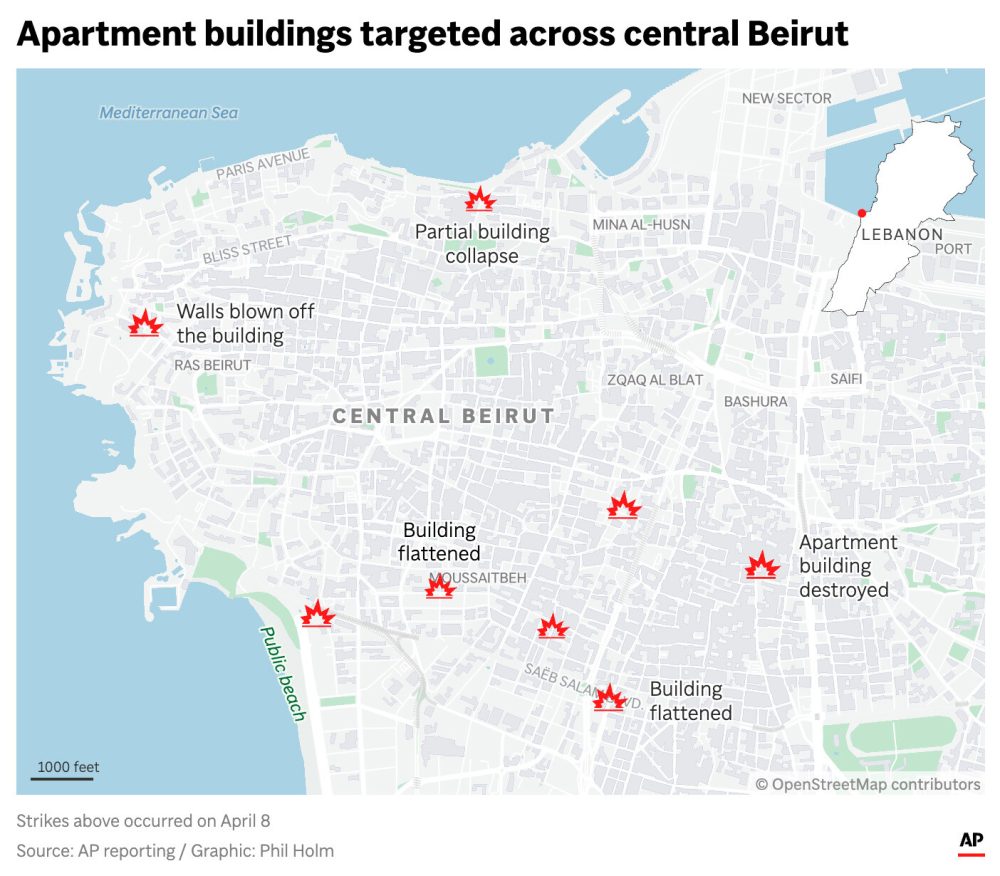 Tracking where Israel bombed central Beirut on the war’s deadliest day
 Brazil’s Supreme Court postpones decision on how Rio picks a governor, extending political chaos