
Exclusive: Islamic Regime Issues Directive To Counter Potential US Ground Military Operations
The state-affiliated Tehran Times, citing “an Iranian security analyst,” reported that in the event of a US ground attack, Iran would seize the coastlines of the UAE and Bahrain.
By Omid Habibinia/The Media Line
A well-placed source told The Media Line that, under a newly issued directive, the regime ruling Iran is taking measures to prepare for a potential US ground assault, as well as to counter possible diversionary and disruptive operations in the capital and major cities, particularly in the south and northwest of the country.
According to the source, the directive—circulated by bodies operating under the General Staff of the Armed Forces and, by implication, aligned with decisions of the Commander-in-Chief and his two key institutions, the Supreme Defense Council and the Supreme National Security Council—has been disseminated to various military and security units.
These units have been instructed to ensure readiness, secure sensitive areas, establish necessary deployments, and prepare for the possible “intervention of hostile field elements across different regions.” Crucially, they have also been authorized, if necessary, to engage independently, even without direct orders from central command.
The directive, which bears resemblance to “Operation Valkyrie” during Nazi Germany, effectively grants each military and security unit the authority to act autonomously—what authorities describe as “fire at will” (Atash be Ekhtiar)—without awaiting instructions from higher command. This suggests that the regime anticipates an escalation of the war, including the possibility of a US ground incursion into Iranian territory, and even the seizure of parts of the south or strategic islands.
It also indicates that authorities are preparing for a scenario in which centralized command structures or communications networks could be severely disrupted, necessitating the decentralization of operational authority.
The directive further reveals that Iranian military commanders view the threat posed by armed groups in Tehran and other major cities, as well as in Iranian Kurdistan, as highly serious. In addition, large segments of tribal populations and communities across western and southwestern Iran have access—often illegally—to firearms, primarily hunting rifles. In eastern Iran, armed Baloch groups also remain active.
It appears that propaganda by the Mojahedin-e Khalq regarding operations by its so-called Liberation Army and “Rebel Units,” along with rumors about the existence of an “Immortal Guard” (Gard e Javidan) aligned with monarchist supporters—recently addressed publicly for the first time by Reza Pahlavi ahead of the Chaharshanbe Suri celebrations—has heightened regime concerns.
Recent US military activity, including the deployment of Marines and airborne forces to the region, as well as repeated references by Donald Trump and other American officials to the possibility of a ground operation, have further intensified fears within the Islamic Republic leadership. This concern is reflected in statements by Mohammad Bagher Ghalibaf, the Speaker of Parliament—despite holding no formal executive or military authority—who has publicly warned the United States against any ground attack on Iranian islands.
Farzin Nadimi, a senior fellow at the Washington Institute and an analyst of Iranian military and security affairs, told The Media Line that a US ground operation aimed at temporarily controlling certain islands or coastal positions overlooking the Strait of Hormuz appears plausible.
He said, “What appears more likely in the near term is not a full-scale ground invasion, but rather limited, selective, and complementary ground operations—such as special forces missions and efforts to temporarily control certain islands or strategic coastal positions overlooking the Strait of Hormuz.”
“Such a scenario differs fundamentally from an all-out ground war, yet remains costly and high-risk. Entering mainland Iran for occupation or deep advances would require a large force, substantial logistical support, and sustained political will—factors that could quickly turn the conflict into a prolonged and attritional war,” he added.
Despite the importance of such a development in weakening the regime’s position, Nadimi explains, the ultimate outcome of the war will still depend on the continuation of the air campaign and its ability to decisively throw the Islamic Republic off balance.
Previously, The Media Line published an audio recording attributed to a Basij commander in Tehran, in which he explicitly stated that, in the event of a drone attack, Basij forces should “clear the area,” retreat into surrounding alleys, and take up positions “so that if any hostile armed force activated, they can engage.”
The assessment within the Islamic Republic’s armed forces is that the next phase of the conflict could involve ground warfare and urban combat. On Thursday, the state-affiliated Tehran Times, citing “an Iranian security analyst,” reported that in the event of a US ground attack, Iran would seize the coastlines of the UAE and Bahrain.
Amid reports suggesting that the US military is preparing for a “final strike,” Iranian authorities appear to consider scenarios such as a military invasion, the seizure of Kharg Island or other strategic islands, and even parts of southern Iran near the Strait of Hormuz as entirely plausible.
The newly issued directive indicates that, in the absence of Mojtaba Khamenei—the nominal leader, who has largely disappeared from public view—the regime’s leadership is preparing for an escalation of the war and the prospect of direct ground engagement.
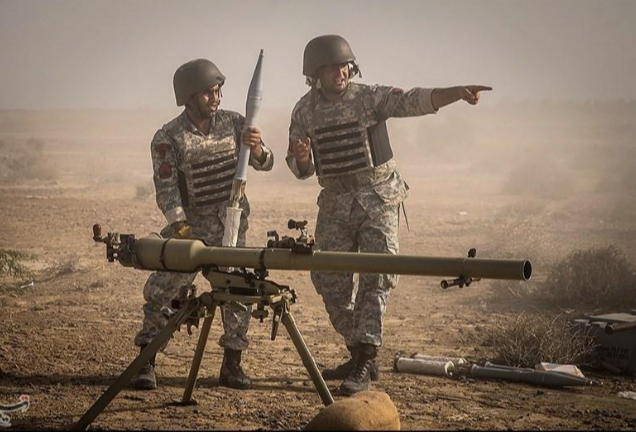
PHOTO-Ground #1: According to exclusive information obtained by The Media Line, military and security units have been instructed to act independently, if necessary, under specific directives to counter a ground attack or hostile enemy invasion. This image shows one of Iran’s military exercises in recent years near the Strait of Hormuz. (Erfan Kouchari/Tasnim)
Brought to you by www.srnnews.com
 Oil spill deals economic blow to fishermen in the Gulf of Mexico
 The Media Line: Iranian Strikes Kill One in Tel Aviv, Wound 19 in Beit Shemesh; Houthi Drone Intercepted Over Eilat
 Yemen’s Houthis say they launched second attack on Israel in less than 24 hours