
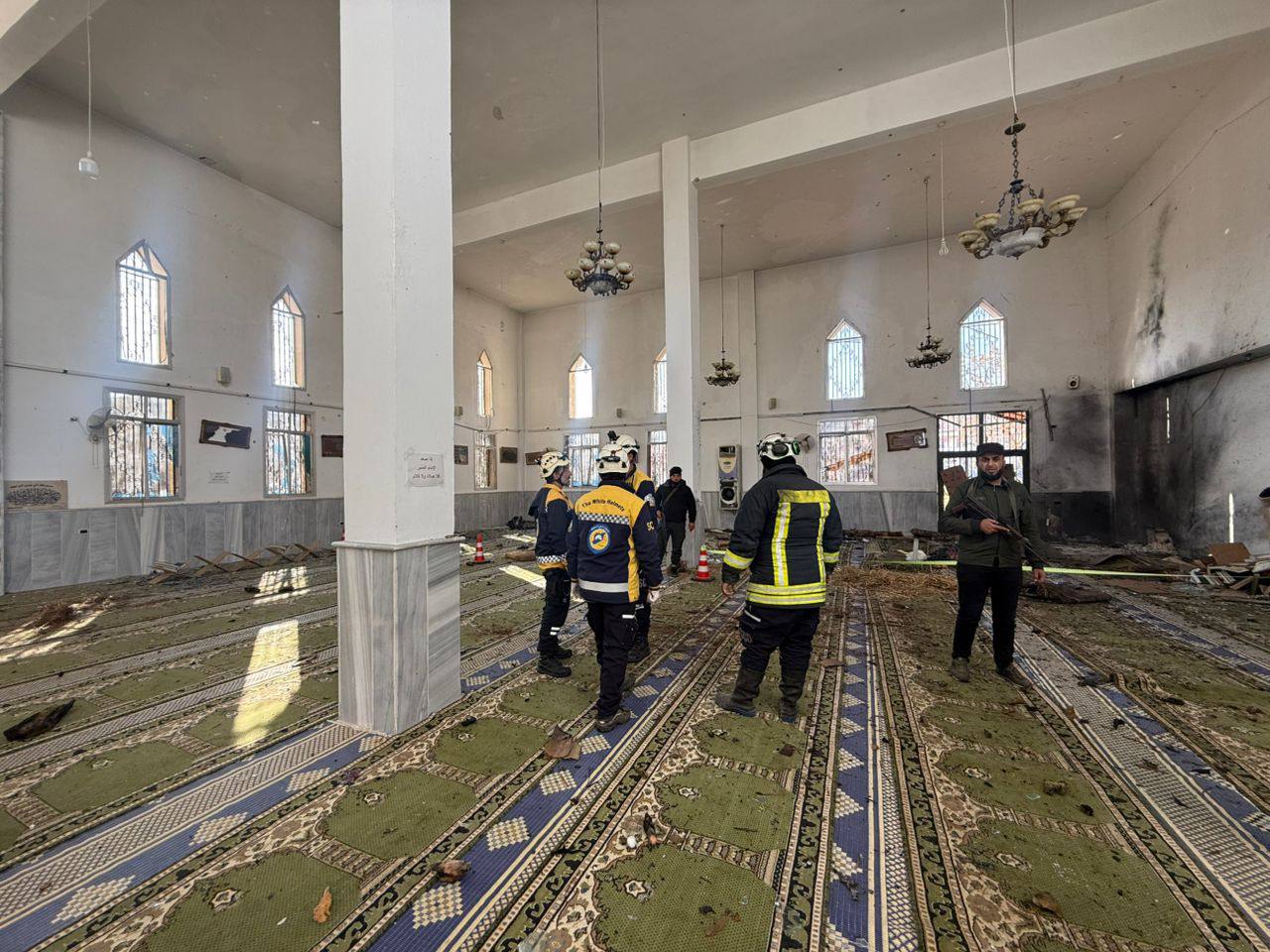
Eyewitnesses Tell The Media Line About the First Moments of the Terrorist Attack on Imam Ali Mosque in Homs
Hours after the explosion, an armed group known as Saraya Ansar al-Sunnah claimed responsibility through an official statement
By Rizik Alabi/The Media Line
HOMS] Friday afternoon was far from ordinary in the Wadi al-Dahab neighborhood of Homs, as the city witnessed one of the deadliest attacks on civilians and places of worship in recent times. While worshippers were performing Friday prayers at the Imam Ali ibn Abi Talib Mosque, a violent explosion shook the entire building, spreading panic and chaos among the congregants, who suddenly found themselves engulfed in a cloud of smoke, blood, and shrapnel.
The bombing caused widespread shock in Syria, particularly since the targeted mosque was in a predominantly Alawite area. The mosque is considered an important religious and social center, with worshippers frequently attending. Targeting this mosque during prayer is not viewed merely as an attack on a place of worship, but is also a direct threat to civil peace, deepening fears of attempts to incite sectarian strife and threaten fragile stability in a city that has long suffered from the effects of war and violence.
A security spokesperson told The Media Line—while refusing to disclose his identity—that the bombing constitutes “a heinous and cowardly terrorist act that targeted unarmed civilians while they were performing their religious rituals,” stressing that this attack represents a blatant violation of all human and religious values.
He added that security services immediately launched an extensive investigation to uncover the circumstances of the bombing and the parties involved, emphasizing that “targeting places of worship, regardless of their sect, is a red line that will not be allowed to be crossed.” The spokesperson also affirmed that the state is committed to protecting all citizens without discrimination and that such acts will not succeed in undermining the national fabric or dragging the country into a new cycle of sectarian violence.
It occurred around 12:30 p.m. on Friday, at a time when the mosque was crowded with worshippers, which resulted in a relatively high number of casualties in a short space of time.
According to the official tally released by the Homs Health Directorate, the attack left eight dead and 19 wounded with varying degrees of injuries, two of them in critical condition. The injured were quickly transported to hospitals for treatment amid a state of medical and security alert.
Bashar Mohieddin Al-Issa, one of the survivors, told The Media Line about what he experienced inside the mosque. Bashar said the explosion occurred during the first phase of prayer while most worshippers were in prostration.
“I heard a tremendous roar, felt as if the air vanished instantly, then a strong pressure knocked me to the ground,” said Bashar, who suffered shrapnel injuries to his leg and back. “When I lifted my head, people were screaming—some bleeding, others motionless. The carpet was torn, and blood was everywhere. I couldn’t understand what happened; everything collapsed in an instant.”
In a weary voice, he added, “We entered the mosque to pray; we never expected to leave it wounded. That is what hurts the most.”
Abu Ahmed, a resident of the neighborhood, was slightly injured but lost his nephew in the blast.
He told The Media Line: “We entered the mosque together; he was a few steps ahead of me. After the explosion, I didn’t see him. I shouted his name, but my voice was lost among the screams.”
“Shoes were scattered, blood on the floor and walls. I was looking for him among the corpses and injured. I wasn’t looking for a wounded person … I was looking for a part of me,” he continued.
Ahmed added, “This explosion didn’t just kill people; it broke something inside us. Even the mosque is no longer the same.”
The effects of the explosion did not stop with those inside the mosque. Umm Khaled, also a neighborhood resident, told The Media Line that her husband never returned late from Friday prayers.
“I was preparing lunch and waiting for him as usual. But this time, the wait was long,” she said. “I heard the explosion from home. At first, I didn’t understand, but my heart sank. Minutes later, people started running in the street, and I realized the mosque had been targeted.”
She rushed to the mosque, but security personnel prevented women from approaching. “I stood at the door, crying and praying that he would return safely.” Shortly after, her husband emerged on a stretcher, injured by shrapnel in his shoulder and chest.
“When I saw him lying there, it felt as if the ground had slipped from under me. I didn’t scream; I just held his hand.” She concluded bitterly: “How do I explain to my children that their father was injured just for going to pray? Fear has entered every home.”
Dr. Nizar Al-Soum, director of Karam Al-Louz National Hospital, told The Media Line that the hospital received an immediate report of the explosion and raised its alert level, summoning medical staff, including doctors and nurses. He added that some injuries required urgent surgical intervention, while critical cases were transferred to other hospitals depending on the severity of wounds. He confirmed that most cases were stable, except for two under close observation.
Authorities imposed a full security cordon around the mosque and surrounding areas. Hassan Al-Farij, Homs security operations official, explained that preliminary investigations indicate the explosion was caused by an explosive device planted inside the mosque and that work is ongoing to identify the perpetrators and clarify the circumstances of the incident.
Rabee’ Jundiyeh, director of Emergency and Disaster Management in Homs, told The Media Line that civil defense teams responded immediately, secured the entire site, and transported the injured with the help of residents. The bodies were removed following protocols intended to respect the victims’ families.
Hours after the explosion, an armed group known as Saraya Ansar al-Sunnah claimed responsibility through an official statement. Meanwhile, authorities emphasized that investigations are ongoing to identify those responsible and uncover the motives behind the attack.
Saraya Ansar al-Sunnah is a new jihadist group in Syria that has, in recent months, pledged to pursue members of the Alawite, Shiite, and Druze sects. It has claimed responsibility for numerous killings and has also threatened to pursue those referred to as the “remnants of Assad.” It has likewise not concealed its disdain for the government of interim President Ahmad al-Sharaa, although it has not called for confronting him.
Its connections to other jihadist movements have not yet become clear, but it appears to be proceeding “along the path of the organization known as the Islamic State (IS).”
The group announced its emergence in late January of last year via a Telegram account. The group’s messages initially included threats against Alawites regardless of their gender or age, as it stated, although it later toned down the severity of these threats. Nevertheless, its rhetoric in general is extremely violent, and its contempt for Shiites closely resembles the rhetoric of IS and its supporters.
Since then, the group has continued incitement and threats, in addition to claiming attacks primarily targeting members of the Alawite sect, to which former President Bashar Assad and those described as remnants of his regime belong. The group has also claimed responsibility for attacks on what it described as “shrines of the polytheists,” referring to some Shiite religious sites in Syria.
The relatively new jihadist group announced responsibility for the attack on the Mar Elias Church in Damascus on June 22, which claimed the lives of at least 25 people, describing it as a response to “Christian provocations against Sunnis.”
Syria’s government strongly condemned the bombing, describing it as an attempt to destabilize security and order, affirming that the perpetrators would be pursued and security measures around places of worship would be strengthened.
The United Nations secretary-general condemned the attack on the Imam Alil Mosque, describing the targeting of a mosque during prayers as a “horrific crime and a blatant violation of international humanitarian law,” calling for accountability for those responsible and protection for civilians.
A UN humanitarian coordinator in Syria also expressed shock, emphasizing that targeting civilians in places of worship exacerbates the community’s suffering. Saudi Arabia, Qatar, Jordan, and Egypt also condemned the attack, calling it a cowardly terrorist act against innocents that undermines stability, while Turkey stressed the need to confront extremist organizations.
Effects of the explosion went beyond the casualty numbers, affecting the Hom’s psychological and social fabric. In the Wadi al-Dahab neighborhood, grief and anger prevailed, along with the daily, fearful question: Are places of worship still safe?
Analysts say that targeting a mosque during Friday prayers aims to undermine collective feelings of security and spread terror, emphasizing that confronting such attacks requires not only heightened security but also long-term psychological and social support for the victims.
Killing individuals is not the sole aim of the attack; terrorists seek to undermine community trust in protection and safety, creating an atmosphere of fear and chaos, according to analysts.
The attack on Imam Ali Mosque in Homs was not just a security incident; it was a deep human and societal tragedy that affected the entire city’s sense of safety. It forced the local community to reevaluate its confidence in the security of places of worship. The incident left profound psychological scars on survivors and residents.
At the same time, international and regional condemnations highlighted the imperative to protect civilians and places of worship as a global humanitarian and moral duty.
Photo Credit: Ahmed Al-Khatib/The Media Line
Brought to you by www.srnnews.com
 Polls open for military-ruled Myanmar’s first election in 5 years
 Myanmar polls open amid civil war, junta-backed party tipped to win
 The Media Line: Israel Recognizes Somaliland as Sovereign State, Opens Path to Broader Cooperation