
It’s All About the Narrative: Israel Fights Back
Terror attacks, political rhetoric, and digital incitement are forcing Israel and its allies to confront antisemitism as a security and democratic threat
By Gabriel Colodro/The Media Line
“A wood cricket is an insect that detests water,” Lebanese-born Jewish Canadian marketing professor, evolutionary psychologist, and author Gad Saad told the audience. “It wants nothing to do with water.” In his telling, the parasite doesn’t attack the insect directly. It changes its behavior. The cricket is driven to jump into water, where the parasite can reproduce, even though the act goes against the insect’s survival instincts.
The metaphor landed because it matched what many in the room were trying to describe: a climate in which antisemitism doesn’t arrive wearing one, easily recognized uniform or announcing itself with a single slogan. It slips into institutions and vocabularies that are supposed to protect people—human rights language, political activism, academic jargon, legal argument—and bends them until they start doing the opposite of what they claim.
This was the atmosphere that framed Jerusalem’s International Conference on Combating Antisemitism on January 26-27, which coincided with International Holocaust Remembrance Day. But the tone in the halls was not commemorative. It was operational. Speakers treated the central question to be answered less as “How do we teach history better?” and more as “How did hate become socially usable again—and why did so many democracies fail to stop it before it turned violent?”
Israel’s minister of diaspora affairs and combating antisemitism, Amichai Chikli, at the outset, rejected the idea that the problem can be managed with softer language and broader disclaimers. “For decades, the fight against antisemitism has been driven by good intentions and by false illusions,” he said. “There was the belief that if we choose the right words, avoid offense, and wrap everything in political correctness, antisemitism will gradually fade away.” Then he drew his line in the sand: “Political correctness and the fight against antisemitism cannot coexist.”
Chikli’s point was not abstract. He listed recent violent cases as proof that the “it’s just discourse” framing has collapsed. “In the past year alone,” he said, “Jews were murdered in Bondi Beach, Sydney, in Manchester, DC, Colorado, and here in Israel, for one reason only: because they were Jews.” He insisted the response requires a willingness to say what many governments avoid saying: “You do not defeat antisemitism by pretending it has no clear source or ideology behind it. And if we are serious about fighting antisemitism, we must name it, define it, confront it.”
One reason the gathering drew so much attention within the diplomatic community was the presence of Albanian Prime Minister Edi Rama—the only sitting foreign head of government to attend in person and the most prominent active leader on the roster. His speech avoided the cautious choreography common in international forums. “Antisemitism is not merely hatred against Jews,” Rama said. “It is an assault on the moral architecture of humanity itself.”
Rama anchored his message in Albania’s record during WWII and in the ethical and cultural code of besa—often translated as “a solemn oath”—which refers to an obligation to protect a guest. Recounting the Nazi demand for lists of Jews and their gold, he offered what he described as Albania’s response: “You can take their gold.” Then followed the sentence that drew a sharp reaction in the room: “You cannot take our Jews.” Rama framed that choice as an insistence that societies prove, in concrete terms, that they are willing to protect Jews when it becomes costly.
Israeli President Isaac Herzog steered the conversation toward the moral consequences of historical collapse and the speed at which distortion spreads. “The gates of Auschwitz opened, and the world gazed into the darkness of pure evil,” Herzog said, and then pivoted to the present: “Gathering to remember and to bear witness is not a passive act.” His argument was that remembrance cannot be treated as ritual while public life absorbs narratives that relativize the Holocaust or repurpose its language for political convenience.
The conference’s public programming was only one layer of a broader sequence. It followed a special session at the Knesset, and preceded a gala evening where Prime Minister Binyamin Netanyahu addressed the international delegation, framing antisemitism as part of a wider assault on Israel’s legitimacy and on the idea that truth can still win in public arenas. “The people who burn Jewish flags, the people who shout, ‘Death to Israel,’ they don’t want a Palestinian state,” he said. “They want a Jewish-less state.
Netanyahu’s speech connected the rhetorical ecosystem to real-world violence, citing the Washington attack in blunt terms: “Just recently, two Israeli diplomats were brutally murdered in Washington, DC.” He warned that the line between incitement and action is thinner than many policymakers want to admit: “It starts with words. It can end with bullets.”
That linkage—words to violence—surfaced repeatedly in the panels, including one titled The Right’s Crossroads: Antisemitism and the Far Right. The session wasn’t a generic debate about ideology. It became a practical argument about persuasion; how to confront antisemitic narratives without using messaging that alienates the very audiences you’re trying to reach.
Political commentator Karys Rhea delivered the sharpest on-stage challenge of the day, directing it at Chikli—supportive in tone, but openly critical about strategy. “Minister Chikli, I love you from the bottom of my heart,” she began, “but if you are talking to a group of America First conservatives, do not bring up Germany as an example with their banning of Holocaust denial and arresting people for hate speech.” She argued that persuasion requires cultural translation, not a one-size-fits-all script. “If we want to address antisemitic tropes and we’re talking to populist right-wingers,” Rhea said, “we need to get people to understand that Israel is having more babies than any other developed country in the world, that Israel still has strong national pride, that masculinity and the warrior mentality are still valued.”
Her point was to sharpen the fight and to stop treating antisemitism as if it speaks one dialect. “We need to be doing twice as much work now,” she said, calling for fluency on right-wing conspiracy claims as well as progressive anti-Israel narratives. She warned that the spread is accelerating. “This fever,” she said, borrowing a phrase she credited to Reverend Johnny Moore, “spreads like wildfire, and we can’t confront it in the same way that we have been used to doing when we confront it on the left.”
Former Australian Prime Minister Scott Morrison, speaking onstage, used the language of social breakdown rather than foreign policy. After describing the Bondi Beach attack—“when two extreme Islamist terrorists, a father and his son, opened fire on a joyous and innocent gathering of Jews celebrating the first night of Hanukkah”—he argued that the consequences go beyond the Jewish community. He cited Rabbi Lord Jonathan Sacks’s warning that “the hate that begins with the Jews does not end with the Jews,” and turned it into a diagnosis of national fragility. “Australians must confront not only the security and intelligence failures exposed by these attacks, but the fragility of our own society that was shredded by the antisemitism that was unleashed in Australia after October 7, long before these murders were committed.”
Morrison described the cultural lead-up as plainly as he described the violence. “Within 48 hours of October 7,” he said, “pro-Palestinian protesters gathered at the Sydney Opera House chanting violent antisemitic slogans.” He portrayed the public sphere as permissive long before it became shocked.
That same fear—late reaction, early warning—was a recurring theme in conversations about major Western cities. Former New York City Mayor Eric Adams, speaking with The Media Line, described antisemitism as something that metastasizes when leaders treat it as a niche problem. “This is not just a Jewish issue,” he said. “This is an issue of hate.” Adams argued that normalization is what makes escalation possible. “If I allow this to exist in my city, it’s going to grow,” he warned. “And it’s going to turn into something else.”
The New York context was raised repeatedly during the conference because of the city’s symbolic weight—and the politics surrounding anti-BDS policies. In interviews and on stage, speakers treated BDS not as a fringe campus tactic but as a pipeline between activism, municipal policy, and institutional legitimacy.
Alan Clemmons, a South Carolina Circuit Court judge and founder of American Patriots for Israel, focused on the legal tools states have used to push back against BDS, in particular, anti-BDS frameworks tied to government contracting. Speaking with The Media Line, Clemmons pointed to “the state laws that prohibit BDS for any business that wants to do business with state government or any subdivision of the state,” adding that legal clarity matters because “in order to push back on antisemitism, you’ve got to be able to define antisemitism.”
Clemmons highlighted the adoption of the International Holocaust Remembrance Alliance definition as a practical enforcement tool, not a slogan: “That gives us the ability to call it out when we see it and then to have repercussions for the antisemitism.”
Natasha Hausdorff, legal director of UK Lawyers for Israel, also centered her argument on the narrative vacuum and institutional drift. She told The Media Line that one reason “false narratives and false accusations and, frankly, blood libels have been able to infect the public consciousness,” is that Israel and its allies often left the field open—mistaking silence for strength.
She described an “exponential increase” in antisemitic targeting in the UK and said much of her work now involves students and campus intimidation, but also professions far from the headline protests. “Increasingly, we’re also very involved in the medical profession, in different unions,” she said, arguing that the problem has become embedded across sectors rather than confined to street demonstrations.
The situation in Latin America was framed as a live political front—one where antisemitism, anti-Israel positioning, and institutional legitimacy collide. Argentine Justice Minister Mariano Cúneo Libarona, speaking onstage, described a courtroom issue that becomes a public order problem when governments blur the lines. “There is no ideology that can justify attacks against civilians,” he said. “There is no cause that deserves the massacre of innocent lives.” His message was that democratic systems collapse when they tolerate violence as a political dialect.
Brazil’s delegation carried a different kind of political weight—future-facing rather than retrospective. Senator Flávio Bolsonaro highlighted that point immediately. “I speak today as a senator and as a candidate for president of Brazil,” he told the audience, placing his remarks in the context of Brazil’s upcoming election cycle. His brother, Congressman Eduardo Bolsonaro, speaking with The Media Line, framed the information battle as inseparable from policy outcomes. “Censorship is never the answer,” he said. “Because when you start censoring what I think is wrong, someone else will start censoring what you think is right.” He described a broader drift in many democracies: institutions that once promised neutrality now taking sides—often without admitting it.
The conference also made space for a different set of messengers: those who work where the narrative mutates fastest—online. Shawn Eni, known as TheMossadIL, spoke with The Media Line about how the post–October 7 environment changed audience demands. “You can’t make jokes about what happened,” he said. He described a sudden shift in his role: “There was a period where people were looking for my account for actual news.” His point was that when traditional institutions lose credibility, the public turns to informal channels—and those channels can either correct distortions or amplify them.
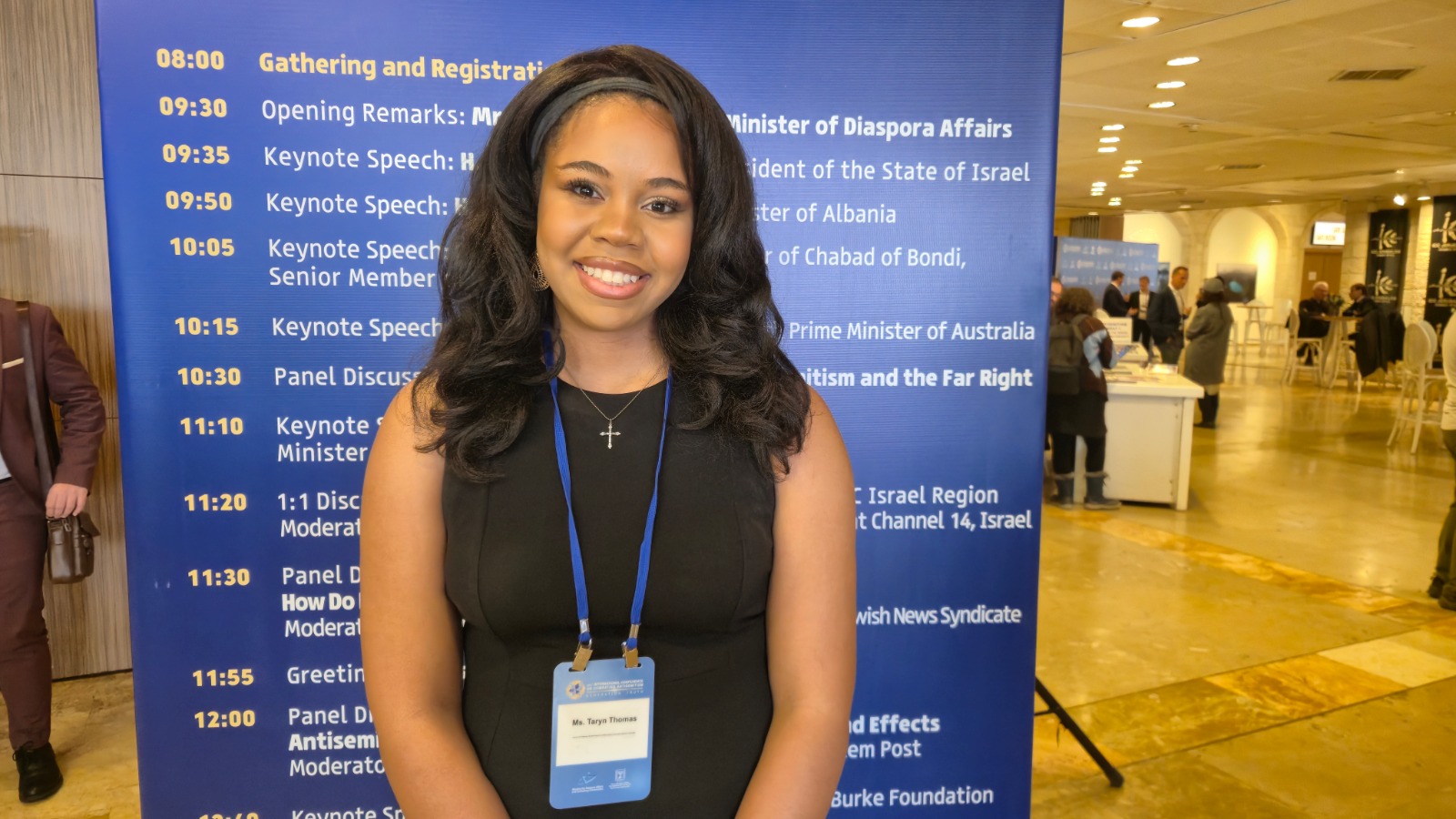
Taryn Thomas, a former pro-Palestinian student organizer who has since become a black-Jewish advocate, offered one of the more personal diagnoses of how movements train people not to question themselves. Speaking with The Media Line, she described a culture of repetition that rewards certainty and punishes curiosity. “Ask questions,” she said. “Interrogate your assumptions about what type of narrative people are feeding you and why.” Her warning was that moral language can be repurposed quickly when group identity becomes more important than accuracy.
American Ambassador to Israel Mike argued that confusion and euphemism are part of the problem and that moral clarity needs to be spoken plainly. “Let’s get real clear about what this is,” he said. “This is not political. It is Jew hatred.” He framed antisemitism as something that thrives when leaders are afraid of being accused of bias. “Sometimes the world says, ‘You need to be neutral.’ Neutrality is an impossibility,” he said, warning that pretending not to choose is, itself, a choice.
Saad’s wood-cricket story landed late in the day, but it captured the thread connecting the sessions: the sense that antisemitism is not simply repeating itself but, instead, adapting itself. “The hair worm lives in water,” Saad said. “So, it needs the wood cricket to jump into water.” His implied comparison wasn’t subtle. The question in the room was whether democratic societies are being nudged—slowly, socially, algorithmically—toward instincts that will harm them, while being told that this is progress.
By the time the halls emptied, the mood was subdued. The speeches, panels, and interviews did something important: they mapped the problem with unusual bluntness and named mechanisms that many governments prefer to describe as “tensions.”
The lingering question was whether diagnosis would translate into action—whether the people who came to Jerusalem would carry this clarity back into legislation, enforcement, education, and the information sphere, where the narrative battle is actually being fought.
Chikli’s formulation—delivered on stage with the cadence of a warning—kept resurfacing in conversation afterward. “This conference is not about slogans. It is about responsibility.” The implication was that the next phase will be judged less by what was said in Jerusalem than by what changes when everyone goes home.
Brought to you by www.srnnews.com
 Texas Democrat’s win a ‘wake-up call’ for Republicans ahead of 2026 elections
 The Media Line: Gaza Begins To Reopen to the World, Testing Israel’s Postwar Strategy
 The Media Line: New Security Accord Between Damascus and SDF Points to Structural Realignment but Implementation Uncertain