

One Door Closes, Another Opens, as Major Gaps Between Hamas, Israel, and the US Still Exist
Military expert Maj. Guy Aviad tells TML: “Hamas will not give up its weapons or tunnels on its own volition. Without weapons, Hamas has no reason to exist and will be left to fight for its survival.”
By Keren Setton/The Media Line
Emotions were running high in Israel as the remains of the last hostage held in the hands of Hamas were recovered on Monday and returned to burial after over two years.
Ran Gvili was a 24-year-old police officer killed while fighting Hamas terrorists during the surprise Oct. 7, 2023, offensive that triggered the war in Gaza.
“The first to go, the last to leave,” Talik Gvili, his mother, posted on Facebook after receiving the news about the discovery of the remains of her son. “Our hero.”
Gvili became a household name in Israel, as his story about saving a southern Israeli kibbutz from being stormed by Hamas terrorists was memorialized by many. After the release of over 250 hostages throughout the war, his return is supposed to mark the beginning of the second phase of the American-brokered 20-point peace plan.
According to the plan reached under the auspices of US President Donald Trump, Hamas is now supposed to give up its weapons and destroy all of its military infrastructure, including its wide network of underground tunnels.
“Trump deserves credit for ending the war, getting the hostages back, and putting a plan in place which answers Israel’s needs at least in principle,” Professor Jonathan Rynhold, head of the Department of Political Studies at Bar-Ilan University, told The Media Line. “Delivering on that is a whole different ball game.”
As part of the next stages, Israel is expected to withdraw from most of the Gaza Strip.
“At some point, hard decisions will have to be made – either disarm Hamas or going ahead without disarming Hamas, which will not be good for the Palestinians or for Israel. Hamas has to be sidelined,” Rynhold added. “At the moment, it’s hard to see that happening.”
Hamas, which has spent decades building up its capabilities, will not relent so quickly.
“Hamas will not give up its weapons or tunnels on its own volition,” Maj. Guy Aviad, a military historian and expert on Hamas, told The Media Line. “Without weapons, Hamas has no reason to exist and will be left to fight for its survival.”
According to Aviad, already during the fighting, Hamas began filling the ranks emptied by the war and Israel’s aggressive military operation.
Figures released by the Hamas-run Gaza Health Ministry show over 71,000 Palestinians were killed by Israel during the war. While Israel maintains that many of the dead are terrorists, Hamas claims the majority are civilians, with at least 20,000 children among the dead.
According to the United Nations Office for the Coordination of Humanitarian Affairs, over 80% of all of the structures in Gaza have been damaged, and over 77% of the road network in the territory has also been hit.
“The destruction in Gaza is of biblical proportions,” said Aviad. “Israel hit hard at almost all of Hamas’ senior commanders, but Hamas has not been subdued and is here to stay.”
Currently, the Israeli military is holding positions along a demarcation line coined the “yellow line” established under the October 2025 ceasefire. The line divides the Strip into Israeli-controlled and Palestinian-administered areas.
Israeli forces have erected blockades and marked buffer zones that restrict movement and embed military control over roughly half of the enclave.
Israel has maintained it will not withdraw until Hamas has disarmed and is no longer in a position to govern the Gaza Strip.
“Now that one of the main targets of releasing the hostages has been achieved, it is time to achieve the second goal of destroying Hamas,” Nitsana Darshan-Leitner, an Israeli activist attorney, told The Media Line.
Trump’s newly established Board of Peace and the proposed Gaza Stabilization Force (GSF) are intended to oversee the implementation of the 20-point peace plan, which aims to sideline Hamas and shape Gaza’s postwar future.
According to US officials, the Board of Peace would coordinate diplomatic efforts, oversee security arrangements, and bring forward economic incentives intended to weaken Hamas’ grip on Gaza. The GSF is supposed to oversee disarmament and prevent the rehabilitation of the terrorist group. Together, both are intended to create the conditions for a transitional administration in Gaza, reduce Israel’s direct involvement, and open the door to reconstruction efforts.
But significant questions still remain over its ability to enforce the goals, the legitimacy of the two bodies among Palestinians and perhaps most importantly, whether Hamas can realistically be dismantled without a broader political settlement for the Israeli-Palestinian conflict.
“The Israeli military will be the one to disarm Hamas, and this must happen before any other step,” said Darshan-Leitner.
Israeli Prime Minister Benjamin Netanyahu might soon find himself in a difficult position, at odds with his ally in the White House over the implementation of President Trump’s plan for Gaza.
“Trump doesn’t want to ruin the celebration of his Board of Peace and the second phase of his plan,” Darshan-Leitner said. “He will not want to see Gaza bombarded again, but Israel will have to pressure Trump in order to not make progress as long as Hamas doesn’t disarm.”
Turkey and Qatar were major players in reaching the deal that ended the war. As Hamas’ patrons with direct and frequent access to the White House, they are also expected to play a role in the future of Gaza, much to Israel’s dismay.
In the next phase, Trump envisions the Board of Peace and the GSF working alongside regional actors to enforce security arrangements and advance the 20-point peace plan, which calls for a technocratic government to administer the Strip. The proposed model would place day-to-day governance, reconstruction, and aid distribution in the hands of nonpartisan Palestinian professionals, while security oversight and disarmament efforts would be handled externally. Whether this structure can truly sideline Hamas, however, remains deeply contested.
“Hamas is focusing on the benefits it gets from the next phase, mainly Israeli withdrawal, while sidelining the issue of disarmament,” said Aviad. “Hamas will continue to run Gaza in the background while being willing to let a technocratic government take the lead.”
There appears to be a growing divide between American mediation efforts and Israel’s bottom-line demand that Hamas be disarmed and excluded from Gaza’s future governance. That comes alongside an unbridgeable gap between a Hamas bent on securing its survival and Israel determined to destroy it.
“The Americans will try to get Israel to begin the second phase in areas where the army is still present,” said Rynhold. “They will also attempt, through Turkey and Qatar, to push Hamas toward some form of disarmament. It is likely that whatever they achieve will be insufficient for Israel, which wants Hamas out of power and stripped of the arms, pressure, and leverage that allow it to shape events in Gaza.”
Israel is heading to elections in the fall of October 2026. Throughout the war, Netanyahu has been accused by the opposition of favoring his own political survival over the fate of the hostages and the handling of the war in Gaza. Within his coalition, he was frequently criticized for not being forceful enough against Hamas and giving in to American demands. As he heads for re-election, he will be faced with similar backlash regarding the future of Gaza, the implementation of Trump’s peace plan, and removing the threat of Hamas, as he vowed at the beginning of the war.
“There will be tensions between Israel and the US around these issues,” he added. “Netanyahu would like to avoid a head-on clash with his coalition or with Trump.”
As Washington pushes forward on its vision for Gaza’s future, the gap between Trump’s ambition and the reality on the ground will become increasingly harder to ignore. Whether Trump’s plan can translate from plans to actions will depend largely on who will be able to hold on to power in Gaza.
Brought to you by www.srnnews.com
 US, Greenland and Denmark start diplomatic talks to ease Trump tensions
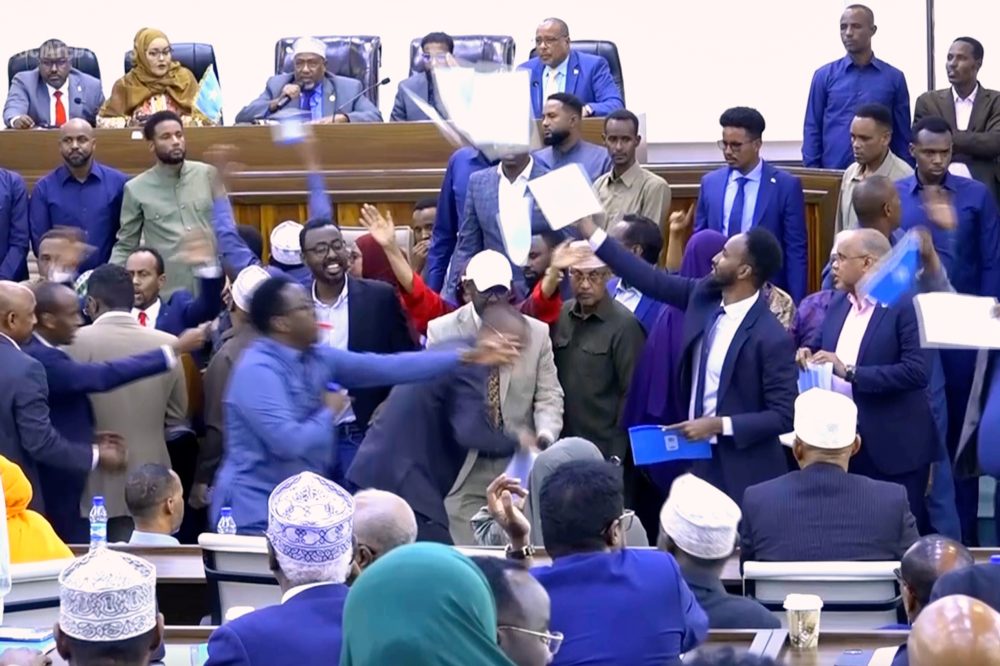 Chaos erupts in Somalia’s parliament over proposed constitutional amendments