‘They Never Imagined Brothers from Israel Would Come’: Quake Aid Opens Rare Door in Venezuela
An Israeli government mission and Jewish humanitarian groups are working in quake-hit Venezuela, but officials are careful not to call it normalization
By Gabriel Colodro / The Media Line
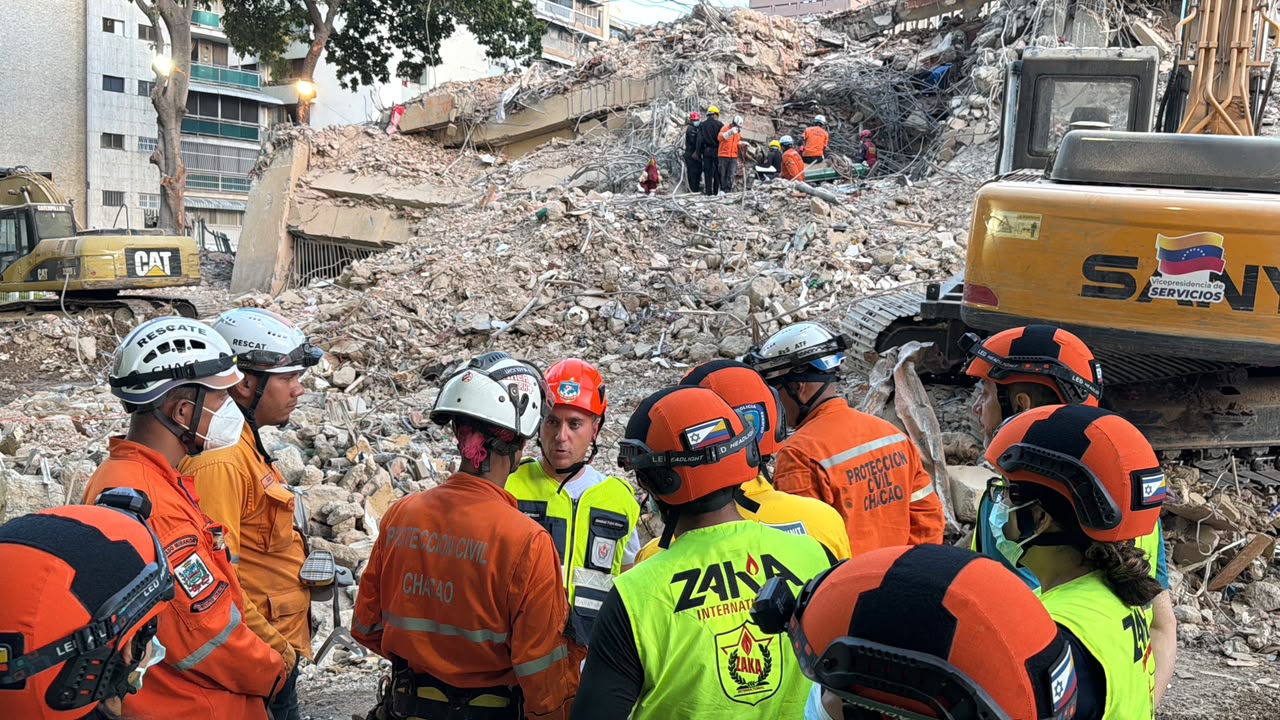
Israel’s ambassador-designate to Mexico, Yoed Magen, arrived in Venezuela at the head of a team that, until recently, would have been hard to picture in Caracas: army officers, engineers, and Foreign Ministry personnel from a country that has had no diplomatic relations with Venezuela since 2009.
The delegation has about 30 Israelis on the ground, most of them from the military and the Foreign Ministry, Magen told The Media Line. Another 20 specialists are working from Israel, reviewing material sent from the field and helping prepare recommendations for a national emergency-response plan. The team is expected to stay in Venezuela for about 10 days.
Their work begins after the first rescue phase. Magen said the Israelis are not there for a classic search-and-rescue operation, but to help answer a more immediate question for local authorities and displaced families: What is still safe to use? The team is inspecting damaged buildings and infrastructure, drawing on the Israel Defense Forces (IDF) Home Front Command’s experience in disaster zones abroad.
That means going building by building, Magen said. Some can be entered. Others are unsafe or at risk of collapse. A third group may be repairable, but not before engineers decide what must be done and who can safely return.
He described the Israeli presence as humanitarian. There are no diplomatic relations between Israel and Venezuela, and he did not present the visit as a political opening. But after a disaster of this size, he said, the two sides had to find a way to collaborate.
Most of the team’s work so far has been in Caracas. La Guaira, Magen said, is different. The coastal city north of the capital has entire areas where the damage is visible from one building to the next. Some structures are gone, others are standing but badly compromised, and families are still waiting to know who is missing and who may yet be found. Magen said the number is in the thousands, perhaps even higher.
The figures released by Venezuelan authorities are already grim: 3,535 dead, 16,740 injured, and close to 18,000 people without homes. Officials have also listed 855 damaged buildings and 189 collapses. In La Guaira, the numbers translate into a slower, more personal problem. People need inspections, relocation, and clear answers on whether the places they left behind are homes, ruins, or something in between.
Prof. Shmuel Marco, a geologist at Tel Aviv University, told The Media Line that the destruction in Venezuela was caused by a convergence of geological, structural and human vulnerabilities. The first factor, he said, was that this was not one earthquake but two, striking about 40 seconds apart.
“This was a double earthquake, and that means the ground was hit twice in a very short period of time,” Marco said. “The second shock came before buildings, infrastructure and people had any real time to recover from the first.”
Marco said Caracas was especially exposed because it sits in a valley that can amplify seismic waves. The damage, he added, was not only a matter of magnitude but of direction.
“The most destructive waves are the horizontal ones,” Marco said. “Buildings are naturally designed to resist gravity, but earthquakes push them sideways. If a structure is not designed for that kind of force, it can fail very quickly.”
From photographs and aerial images, Marco said many buildings appeared to have collapsed in one direction, almost like card structures. To him, that suggested they were not built or reinforced to withstand strong lateral shaking. He said Venezuelan geologists had warned for years that a major earthquake in the region was likely, particularly around the Boconó fault system north and west of Caracas. “This earthquake was expected and yet surprising,” Marco said. “Venezuelan geologists had warned for years that this kind of event was likely, but the country was not ready for it.”
That lack of readiness, Marco said, does not mean any country could have handled the disaster easily. He compared the scale in Caracas and La Guaira to a much smaller collapse in northern Tel Aviv years ago, where recovering two bodies from a parking structure required about a week of work, around 100 people, and heavy machinery. In Venezuela, he said, the challenge is multiplied across hundreds of buildings. “No country in the world can respond immediately and fully to hundreds of collapsed buildings,” Marco said. “Even wealthy and well-prepared countries would struggle with a disaster on that scale.”
The Israeli government delegation is only one part of the broader Israeli and Jewish response. When the earthquakes hit Venezuela, Rabbi Yosef Garmon, former Chief Rabbi of Guatemala and CEO and President of the International Humanitarian Coalition, began calling the same kind of people he had called after disasters in Nepal, Haiti, Turkey, Syria, Mexico, and Central America. Some were trained through ZAKA International. Others belonged to Jewish volunteer networks in Guatemala, El Salvador, and Colombia. The first task was simple: find who could move, what supplies could be gathered, and how quickly they could reach the disaster zone.
The first group from Central America reached Venezuela two days after the quake. Others followed from Colombia, including doctors connected to the local Jewish community. They brought supplies, more than a ton from Colombia alone, Garmon said, and began working with local partners, among them the Central University of Venezuela.
By then, he said, the work had already moved beyond the first hope of rescue. His volunteers were helping with food, tents, medicine, masks, gloves, and other supplies for people made homeless. In some places, families also needed help with the hardest task. “Sadly, by the time we arrived, we were no longer rescuing people alive,” Garmon said. “But families still needed help recovering the bodies of their loved ones. Some of them told us, with tears in their eyes, that they never imagined brothers from Israel would come to help them in that moment.”
For Garmon, the response in Venezuela has three layers: the government, the general population, and the Jewish community. He said Venezuelan authorities helped facilitate access, security, and movement. Ordinary Venezuelans, he said, responded with unexpected warmth toward the Israeli and Jewish teams, including in the streets, universities, and online. The Jewish community, meanwhile, opened its institutions and became part of the operation itself.
The symbolism was strongest inside Venezuela’s Jewish community. Magen said the different Israeli and Jewish groups had separate missions, but that their encounters carried special meaning. Over Shabbat, the community hosted Israeli state officials, uniformed IDF soldiers, and Jewish volunteers from several countries together for the first time in decades. Garmon said Club Hebraica opened its doors, community members organized a large collection center, and Venezuelan Jews of all ages helped prepare donations for families affected by the earthquakes.
The official Israeli mission, Garmon said, is not the same as that of the volunteers. “The official Israeli delegation has a different mission,” Garmon said. “They are looking toward Venezuela’s future reconstruction. Their work and ours are separate, but they complement each other.”
Other Jewish and Israeli groups have also been involved. IsraAID has focused on psychological first aid, children, water, sanitation, and hygiene needs, while additional organizations from Israel and the wider Jewish world have mobilized supplies, expertise, or volunteers. Garmon said the combined response showed something broader than a state operation. “For us, there is no difference between Jews and non-Jews,” he said. “We help human beings. Wherever there is a need, that is where we try to be.”
The diplomatic background makes the moment unusual. Venezuela cut ties with Israel in January 2009 under Hugo Chávez during Operation Cast Lead in Gaza, and the rupture continued under Nicolás Maduro. For years, Caracas maintained one of Latin America’s most hostile official lines toward Israel while deepening ties with Iran. That history is why the public acknowledgment from acting President Delcy Rodríguez drew attention. She thanked the Israeli team, credited coordination to the local Jewish community and Chief Rabbi Yitzhak Cohen, and pointed to the Israeli delegation’s role in initiating the infrastructure assessment and rehabilitation process.
Magen said the reception from Venezuelan authorities and the public has been extremely warm. Still, Israeli officials are not presenting the mission as a formal diplomatic breakthrough. The working line from Jerusalem remains cautious: there is coordination because there must be coordination, and Israel is helping because Venezuela is facing a humanitarian crisis. Any broader political meaning is premature.
The earthquake did not normalize relations between Israel and Venezuela. It forced cooperation in the ruins. For the Venezuelan families still waiting for answers, that distinction may matter less than the immediate question of who came to help. For Jerusalem and Caracas, it may matter much more later. For now, the most careful reading is also the most accurate one: this is a humanitarian mission, a rare public opening, and a moment of contact in a relationship that had almost none.
Photos are Courtesy Rabbi Yosef Garmon
Brought to you by www.srnnews.com
 A Mexican village warned of a cartel offensive during the World Cup. Then the drone attacks began
 The Media Line: Lebanon’s Aoun Says Washington Visit Aims To Halt Conflict with Israel