

Zelenskyy Warns ‘AI, Not Only People’ Could Soon Decide on the Battlefield
Ukraine’s rapid adoption of drones and artificial intelligence is reshaping combat even as manpower shortages and traditional attritional warfare continue to constrain Kyiv
By Giorgia Valente/The Media Line
Russia’s war in Ukraine is accelerating technological change on the battlefield while forcing European governments to confront how drone warfare and covert operations could create security risks far beyond Ukraine’s borders.
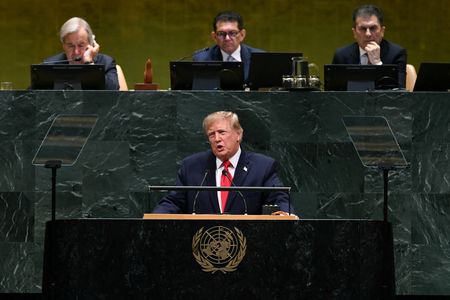
Ukrainian President Volodymyr Zelenskyy brought the technological dimension to the UN General Assembly on Wednesday, warning that artificial intelligence could soon move from assisting military operations to making battlefield decisions itself.
“As early as next year, there is already a real possibility that AI, not only people, will begin to decide what happens on the battlefield. We need peace before we reach that point,” Zelenskyy told world leaders in New York.
His speech also offered a stark accounting of the human cost Russia has incurred. Zelenskyy said Russian forces lost nearly 249,000 soldiers killed or seriously wounded between January and August. The figures are Ukrainian claims and cannot be independently verified.
Zelenskyy has also acknowledged that the battlefield picture remains more complicated than Russian losses alone suggest, saying this week that Russian President Vladimir Putin “is not winning” but also “is not losing,” because the Kremlin has not yet been forced to regard its human losses as strategically prohibitive.
That tension between technological progress and the traditional realities of attritional warfare is central to how Don Bowser, an international anti-corruption, governance and security expert with more than three decades of experience focusing on the post-Soviet space, particularly Ukraine, assesses the conflict.
Bowser cautioned against treating artificial intelligence as if it had already transformed the war by itself.
“Everything is AI. So how much does it directly affect what is going on in the war? Not much. The networking of the drones and unmanned systems, that was long predicted,” Bowser told The Media Line. “What does it do right now on the battlefield in Ukraine? It allows an operator to operate several drones at the same time.”
Ukraine’s technological evolution also predates the current AI boom. Bowser pointed to the role of civil society, NATO assistance, and earlier work on Ukraine’s Delta battlefield management system.
“If it hadn’t been for NATO in 2016, Ukraine wouldn’t have gotten its Delta battle management system, which probably is one of the factors in saving Kyiv during the siege of Kyiv,” he said.
“So, this innovation is driven, not because of the state, but in spite of the state,” Bowser added.
Ukraine has nevertheless become one of the world’s most active testing grounds for drone warfare, autonomous systems and digitally integrated battlefield management. It has also increasingly used long-range drones to strike energy and military infrastructure deep inside Russia.
Those attacks have placed substantial pressure on Russia’s refining industry. Reuters reported Sept. 15 that three of Russia’s six largest diesel-producing refineries had significantly reduced or completely halted output after drone strikes. The six plants together account for roughly half of Russia’s diesel production, and falling output has contributed to fuel shortages and Russian restrictions on fuel exports.
Another major Ukrainian drone operation on Sept. 20 reached the Moscow region and damaged the Moscow oil refinery. The refinery subsequently halted crude processing after fires broke out in its two primary distillation units, according to industry sources cited by Reuters.
Bowser cautioned, however, against interpreting the economic damage as evidence that Russia is approaching collapse.
“Is this impacting on the Russian economy? Yes. Is it impacting on the Russian economy enough to make Russia collapse? No,” he said.
Nor have Ukraine’s growing technological capabilities solved one of Kyiv’s most persistent battlefield problems: manpower.
Bowser said drones and other new systems have given Ukraine important capabilities but cannot compensate fully for shortages of personnel.
“Technology isn’t going to win the war. Robots are not going to win the war either,” he said.
Russia, meanwhile, has continued to adapt while maintaining a sustained aerial campaign against Ukrainian cities and infrastructure. Russian attacks on Sept. 12 killed 10 civilians and injured dozens, according to Ukrainian authorities.
Reuters has also documented Russia’s expanded use of modified RM48U training missiles. The repurposed missiles are less sophisticated than some of Russia’s other ballistic weapons but allow Moscow to maintain pressure on Ukrainian air defenses while conserving more advanced systems.
The technological contest is increasingly influencing NATO’s security planning as well.
Countries along the alliance’s eastern flank have repeatedly raised alerts over aerial incursions and Russian attacks close to their borders. NATO says Russian airspace violations, cyberattacks and acts of sabotage have increased in frequency, while Poland has repeatedly activated aircraft and air-defense systems during major Russian attacks on western Ukraine.
Polish Prime Minister Donald Tusk warned on Sept. 18 that intelligence assessments indicated Russia could carry out drone or missile operations against NATO countries and present them as accidental, complicating the alliance’s response.
Bowser said some of the public discussion of hybrid warfare risks overlooking Russia’s ability to recruit people abroad for intelligence and sabotage operations.
“So this hysteria about hybrid war doesn’t address the real issue, which is Russia’s intelligence capability to be able to recruit people abroad, mostly Ukrainians, and the resources they have,” he said.
Concerns about such operations are no longer confined to countries bordering Russia or Ukraine.
Spanish newspaper El Mundo reported this week that US intelligence had warned several European governments about a possible Russian operation involving Gerbera drones launched from merchant vessels in the Mediterranean against targets in Italy, France or Spain.
The reported warning has not been publicly corroborated. Italian Defense Minister Guido Crosetto said Thursday that the alleged alert had “not been confirmed,” while Italian government sources told ANSA that no warning had reached Rome through intelligence, diplomatic or military channels.
Daniele Garofalo, a security consultant and intelligence analyst, said the reported scenario should be assessed by separating what Russia could technically do from evidence that it has decided to do it.
“If the report were confirmed, the fundamental distinction would be between capability, intent, and operational preparation,” Garofalo said.
“The technical capability to build an operation of this kind is credible. Russia’s intent to maintain pressure on European countries through hybrid tools is consistent with behavior already observed and with the deterioration of the European security environment. Much weaker, however, based on publicly available information, is the evidence of specific operational preparations for an attack against Italy, France, or Spain,” he added.
The scenario nevertheless illustrates how relatively inexpensive drones could create problems well beyond their immediate destructive power.
The Gerbera, a Russian drone frequently used as a decoy, can also carry a small explosive payload. Its limited payload would make it poorly suited to destroying a large military installation on its own, but a successful strike could still close an airport, damage exposed equipment, or disrupt critical infrastructure.
For Garofalo, the more consequential element of the reported scenario is the proposed launch platform.
“The genuinely interesting aspect of El Mundo’s reporting, therefore, is not the drone. It is the ship,” he said.
“With a stated range of approximately 600 km, a Gerbera is not normally a system with which Russia could directly reach much of Western Europe from Russian territory. Transporting the system through the Mediterranean, however, would completely change the operational geometry,” he added.
Launching drones from a merchant vessel could also complicate early detection and attribution. A civilian ship under a third-country flag, with opaque ownership and a multinational crew, could leave governments uncertain about responsibility during the crucial first hours after an incident.
“The problem would not necessarily be preventing final attribution, but delaying it,” Garofalo said. “Twenty-four or 48 hours of uncertainty can have considerable political value during a NATO crisis.”
For NATO countries, the problem would therefore extend beyond the ability to shoot down individual drones. Modern counter-drone and air-defense systems can protect high-value targets, but governments face a much more difficult problem in providing continuous coverage for large numbers of airports, ports, military bases, refineries and other critical infrastructure.
“The capability to counter the threat therefore exists. The problem is the density of coverage,” Garofalo said.
“No country can reasonably deploy C-UAS systems, sensors, electronic warfare capabilities, and interceptors permanently around every airport, port, base, refinery, energy node, and critical infrastructure site,” he added.
The political consequences of any such incident would also depend heavily on the target, damage, and ability to establish responsibility. An intercepted drone that caused no damage would pose a different challenge for NATO than a coordinated attack causing casualties at a military installation.
Garofalo said the most immediate concern is therefore not necessarily a confirmed Russian attack plan against Southern Europe but the possibility of lower-level activity intended to test NATO defenses while preserving ambiguity.
“In the short term, over the next 30–90 days, the most relevant scenario to monitor is not necessarily a direct Russian attack against Italy, France, or Spain, for which there is currently no public evidence of specific operational preparations,” he said.
“A more plausible intermediate phase would be characterized by reconnaissance, probing, and difficult-to-attribute activities designed to gather information on NATO countries’ detection and response capabilities while simultaneously maintaining political pressure without unequivocally crossing the threshold of an armed attack,” he added.
Brought to you by www.srnnews.com
 Lula holds thin lead over Flavio Bolsonaro ahead of Brazil election, Datafolha poll shows
 Trump tells countries to quit ICC. Few follow his lead
 Police arrest actors, politicians protesting against Netanyahu outside UN