
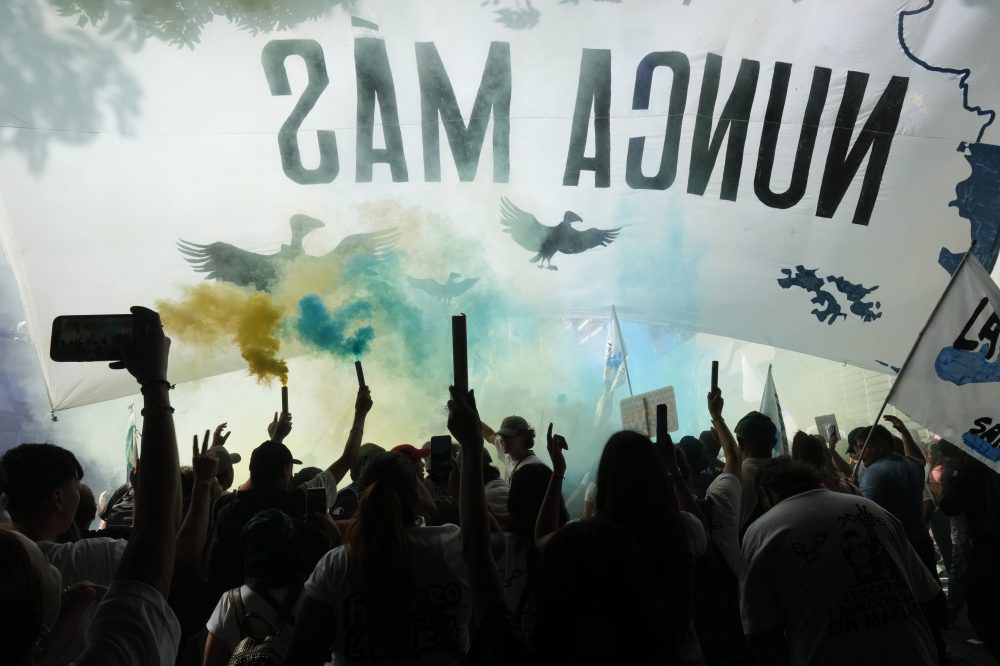
BUENOS AIRES, Argentina (AP) — Thousands marched through Buenos Aires on Tuesday to mark 50 years since the 1976 military coup that ushered in one of Latin America’s bloodiest dictatorships.
An estimated 30,000 people were disappeared by the regime in its campaign against dissidents, including a left-wing guerrilla movement, labor activists and students, according to human rights organizations. Official figures place the number at around 8,000.
A truth commission and human rights groups attribute the majority of violence during that period to state security forces.
Human rights organizations, labor unions, student groups, social movements and political organizations called Tuesday for demonstrations across the country under the slogan “Memory, Truth and Justice,” in reference to crimes against humanity committed during the military regime.
Manuela Casares, a 36-year-old psychologist, told The Associated Press she attends the march every year, but this time decided to bring her nearly 6-year-old daughter “to teach her and pass on our history and the meaning of this day.” She said she believes it is essential to share this with her, since she did not experience those events the way her parents did.
Argentina’s ultraliberal President Javier Milei has insisted that commemorations should also include victims of attacks carried out by guerrilla groups active at the time. Milei on Tuesday shared a quote attributed to Russian political activist Garry Kasparov saying that communism “is against human nature and can only be sustained through totalitarian repression.”
In line with that stance, the presidency released a video titled “Day of Remembrance for Justice and the Full Truth,” featuring two testimonies, one of a young woman who was taken as a baby during the dictatorship and regained her identity in 2017, and another from the son of an Argentine colonel kidnapped by a guerrilla group.
Among the groups calling for the march is the Grandmothers of Plaza de Mayo, an organization founded in 1977 that has worked to locate children taken during the dictatorship. An estimated 500 babies born in captivity were illegally taken and adopted by military families or associates. Around 140 have since been identified.
After the return of democracy in 1983, the state took responsibility for prosecuting those responsible for the crimes but showed less commitment to locating victims’ remains. Efforts have also been hindered by the military’s refusal to provide information about their whereabouts.
Milei’s rise to power in 2023 has further complicated efforts to recover victims’ remains. As part of his austerity plan, he has downgraded the Human Rights Secretariat to a sub-secretariat, cut its budget and laid off staff. Technical teams working on archive analysis were dismissed, accused of political bias and of carrying out what Milei’s administration described as persecution of former military personnel.
___
Follow AP’s coverage of Latin America and the Caribbean at https://apnews.com/hub/latin-america
Brought to you by www.srnnews.com
 Brazil’s Bolsonaro allowed to serve 27-year sentence at home due to ill health
 Denmark’s left-wing bloc leads election but lacks majority, exit polls show
 French tycoon Bolloré denies political war against public broadcaster