
KATHMANDU, Nepal (AP) — Some survivors sheltering in relief camps after deadly floods in Nepal were struggling Thursday to obtain essential medicines and cash, even as authorities provided food and other basic supplies to thousands of displaced people.
For families who lost homes and relatives, the shortages are adding to the hardship of relying on temporary shelters for their basic needs.
Suresh Kumar Karanjit, who has been staying at a relief center in Devighat, in Nuwakot district, lost his younger brother in the floods last week. He said the medicine available at the camp did not match his prescriptions for his heart condition.
With no cash to buy his regular medicine, Karanjit bought it after selling a carton of noodles he received as relief for 400 rupees ($2.60). “We have been living here since a week. The relief materials are being provided, which is good. But there is a lack of medicine,” he said.
Nepal’s disaster chief, Dharam Raj Uprety, said health camps staffed by doctors and stocked with medicine have been set up at each relief center, while authorities are also focusing on hygiene and sanitation to reduce the risk of disease.
The Aug. 26 floods caused by a glacier collapse devastated towns and valleys in Nepal, destroying homes, roads, bridges and other critical infrastructure. At least 1,252 people were killed and more than 4,200 are missing, according to the country’s disaster management agency. China as of late Wednesday said 21 people were killed and 541 were missing on the Tibet side of the border.
Nearly 4,000 people displaced in Nepal are staying in 34 relief centers.
In some worst-affected areas, residents have been finding other ways to navigate after floodwaters left communities cut off from regular routes.
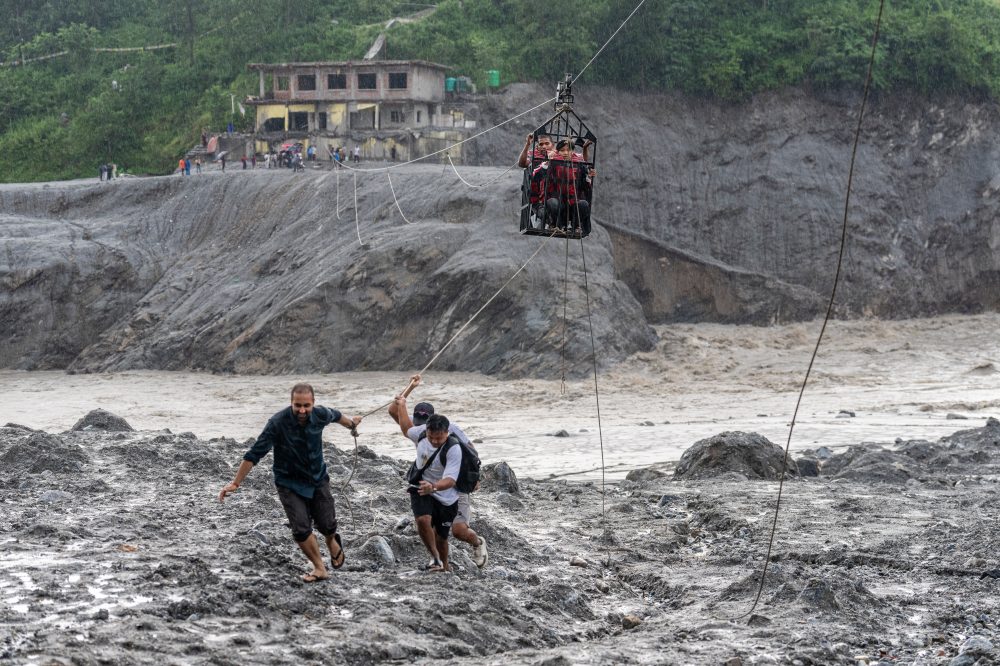
In Bidur town, along the Trishuli River, residents were using a temporary zip line to cross between the riverbanks. Army personnel helped people onto the makeshift crossing and assisted them as they reached the opposite bank, while others waited along the riverbank for their turn.
Meanwhile, rescue efforts have increasingly focused on tunnels at several hydroelectric projects where workers are believed to be trapped. About 900 workers remain missing, while specialized rescue teams from India, China and the United States are involved in efforts to reach those trapped in the tunnels.
It was unclear whether workers feared trapped in the tunnels were alive.
At the Trishuli-3A tunnel, workers have begun manually opening the upper section of the passage, according to lawmaker Ram Neupane. An access road was built over the past week to reach the excavation site, but more rock blasting and debris clearing will be needed before heavy machinery can reach the area, he said.
Brought to you by www.srnnews.com
 USS Lincoln crew hits the streets of Thai beach city after lengthy Middle East deployment
 UK’s Green leader to stand for ex-PM Starmer’s London seat in parliament
 Taiwan proposes extra $4.6 billion in defence spending for this year