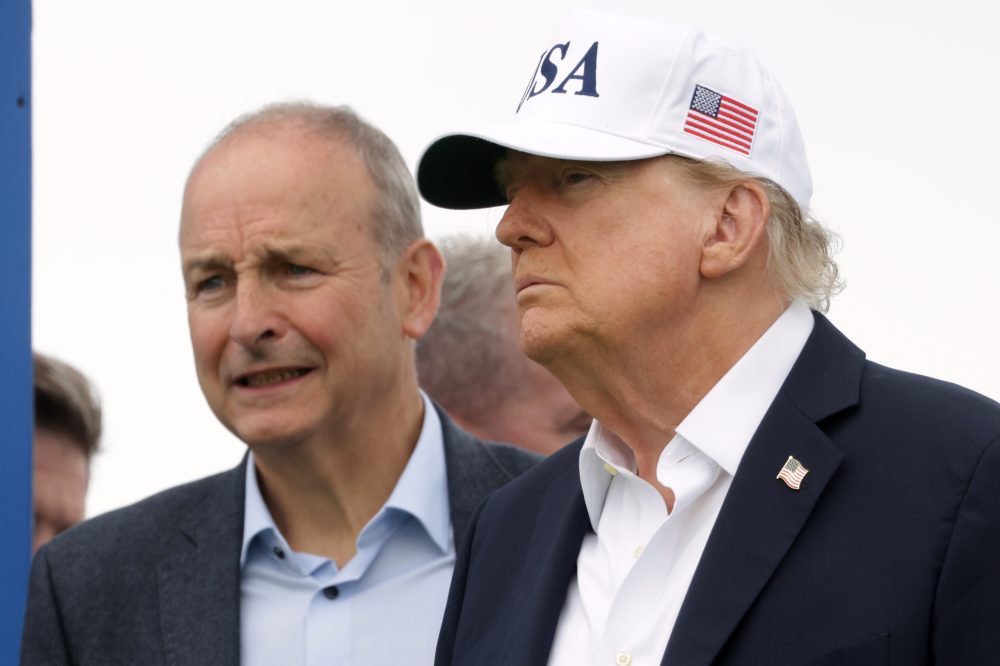
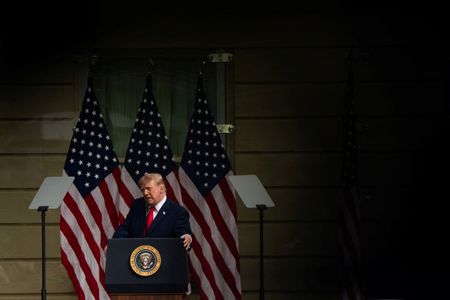
DOONBEG, Ireland (AP) — U.S. President Donald Trump doubled down Sunday on his support for a united Ireland, saying it makes sense to merge the Republic of Ireland with the United Kingdom’s Northern Ireland.
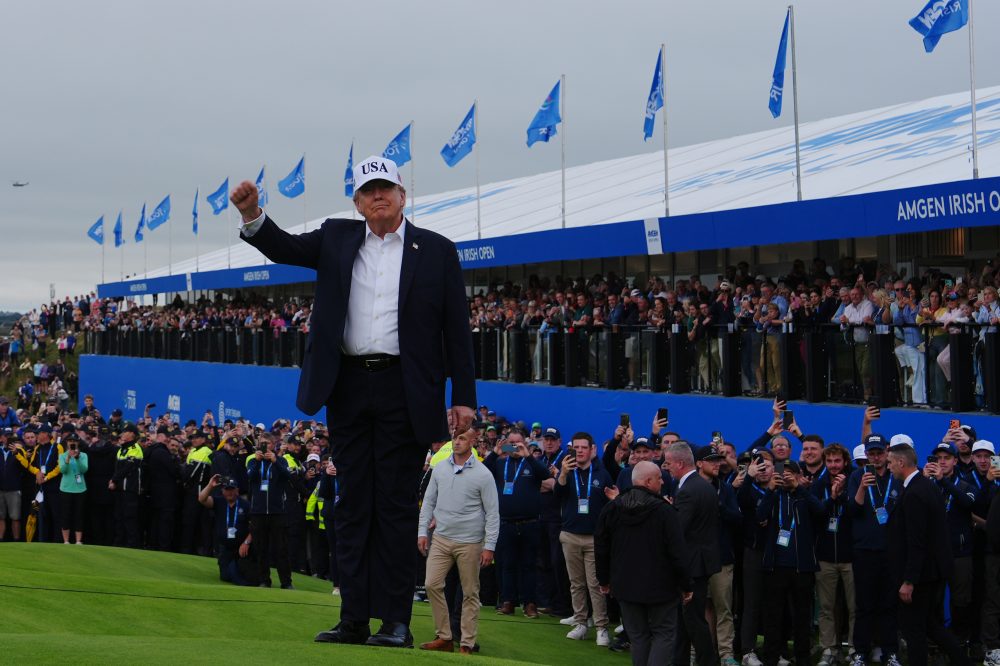
“It just seems to me that you have Northern Ireland and you have Ireland, and it would seem to me that one of the naturals of all time is put them together,” Trump said as he attended the Irish Open at his golf course in Doonbeg, western Ireland.
It’s not that simple.
Trump’s statement Saturday that Irish unification would be “fantastic” touched a live rail in the histories of Britain and Ireland that lies behind a century of division and decades of violence. Reaction, for and against, was swift.
Irish Prime Minister Micheál Martin urged politicians to “keep a calm perspective” on Trump’s comments, and called some of the responses an overreaction.
When Ireland won independence from Britain a century ago and became a self-governing Roman Catholic-majority country, a six-county region in the north, which then had a Protestant majority, remained part of the United Kingdom.
Northern Ireland was split between two main communities: nationalists — most of them Catholic — who desired union with the rest of Ireland, and largely Protestant unionists, who wanted to stay British. In the late 1960s, tensions exploded into “The Troubles,” three decades of violence involving paramilitary groups on both sides and British troops left some 3,600 people dead in bombings, shootings and other attacks.
A 1998 peace accord that the U.S. was instrumental in striking largely ended the violence, but left Northern Ireland’s ultimate status unresolved by allowing people to identify as Irish, British or both. The Good Friday Agreement allows for a vote on unification if polls indicate it would likely pass, a threshold the U.K. government says has not been met. Ireland would also have to approve the change in a referendum.
Peace in Northern Ireland has largely endured, but divisions remain deep over the conflict’s legacy and the region’s competing identities. Despite Trump’s view, the issue of whether Northern Ireland’s future lies with the U.K. or Ireland remains unresolved.
Trump said Sunday that his comments were “only my opinion,” but also that he’d had “so much support.” The British government sought to downplay them.
Prime Minister Andy Burnham’s office pointed back to his statement last week that he was “100%” behind the Good Friday accord and that the U.K. would only consider allowing a referendum “when public opinion has changed to the point where the call has to be considered.”
Opposition U.K. Conservative Party leader Kemi Badenoch said Trump was “shooting from the hip as usual, just like he did with Greenland and Canada becoming the 51st state. This sort of loose talk about the future of democratic countries is deeply unhelpful and creates unnecessary tension.”
Trump’s remarks also were criticized by pro-British unionist politicians in Northern Ireland.
Gavin Robinson, leader of the Democratic Unionist Party, posted on X that “Northern Ireland’s constitutional future will be decided by the people of Northern Ireland, not by commentary in London, Dublin or Washington. Northern Ireland is part of the United Kingdom because that is the settled democratic will of its people.”
Trump’s remarks were striking because previous U.S. presidents – even those with Irish roots, like Joe Biden – have avoided commenting directly on the subject of unification.
Sinn Fein, a political party that seeks unification and was allied during the Troubles with the Irish Republican Army, said it approved of Trump’s comments, although the left-leaning party has little in common with him politically.
Gerry Adams, who was Sinn Fein leader when the Good Friday accord was signed, said the “remarks by President Trump on the issue of Irish unity are welcome, even though we profoundly differ with him on many other matters.”
All the main Irish political parties support unification on paper, but Sinn Fein says Martin’s centrist Irish government has failed to prepare for it to happen.
Martin called some of the response to Trump’s comments “an overreaction,” noting the president had previously asked whether there would be a “merger” between Ireland and Northern Ireland.
“It shouldn’t be a surprise. He takes a different sort of perspective on things, we know that,” Martin said Sunday.
“I believe in Irish unity,” he added. “Many political parties in the Republic believe in our unity. But we also of course believe in the Good Friday Agreement.”
Brought to you by www.srnnews.com
 Trump says he plans to remove a 15% tariff on Irish whiskey
 Russian drone hits train near Ukraine-Poland border soon after visiting dignitaries passed through
 Trump downplays the need to check AI development and says he doesn’t want to cede edge to China
 Trump says he’ll consider whether to release more 9/11 records