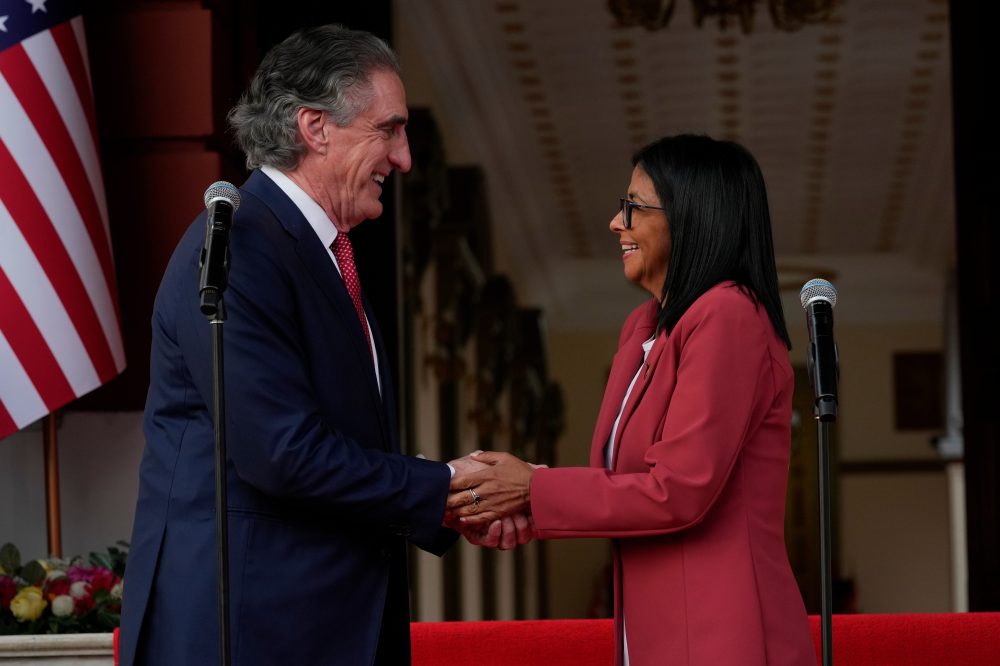
MAIQUETIA, Venezuela (AP) — U.S. Secretary of the Interior Doug Burgum on Thursday said Venezuela’s government is giving security assurances to mining companies interested in investing in the South American country, where mineral-rich areas have long been controlled by guerrilla members, gangs and other illegal groups that mine with consent — and to the benefit — of officials and the military.
Burgum told reporters at the end of a two-day trip to Venezuela that the government of acting President Delcy Rodríguez acknowledged concerns about the security risks. The legal exploitation of mining in those unsafe, difficult-to-reach areas is part of the U.S. government’s phased plan to turn around the crisis-wrecked country.
“We heard assurances in the meeting today and yesterday that if companies wanted to get to these areas, do due diligence, think about reopening mines, maybe even getting back to mines that they themselves were running 15 or 20 years ago, that this government would ensure their security,” Burgum said.
Burgum, who leads U.S. President Donald Trump’s National Energy Dominance Council, postured that the illegal activity “created an economic opportunity where there was none,” but legal investments would bring a “superior economic opportunity.”
Burgum became the latest U.S. official to travel to Venezuela’s capital, Caracas, to meet with Rodríguez, who was sworn in following the capture by U.S. forces of then-President Nicolás Maduro two months ago. His trip comes as the Trump administration seeks to defend against China’s hold on critical minerals — some of which are abundant in Venezuela — and advances its plan to stabilize the South American country that was marred by a complex crisis for the entirety of Maduro’s near 13-year rule.
The Republican administration is making bold moves to shore up supplies of critical minerals needed for electric vehicles, missiles and other high-tech products after China choked off their flow in response to Trump’s sweeping tariffs last year. While the two global powers reached a truce to pull back on the high import taxes and stepped-up rare earth restrictions, China’s limits remain tighter than they were before Trump took office.
In addition to oil, Venezuela is rich in gold, copper, coltan, bauxite, diamonds and other precious mined resources, while unsafe working conditions are common in the poorly regulated industry. The elements niobium and tantalum, both considered critical minerals and crucial for smartphones and the batteries of electric vehicles, are extracted from coltan. Bauxite is processed into aluminum, which the U.S. also lists as a critical mineral.
“I believe the steps we are taking demonstrate the goodwill to build this cooperation agenda in the energy and mining sectors, which will strengthen relations between our two countries for the benefit of the people of Venezuela and the people of the United States,” Rodríguez said on state television.
A day earlier, Rodríguez announced that she would ask lawmakers to work on an overhaul of the country’s mining law to create conditions to attract foreign investment. Part of the changes will mirror a recently approved oil industry reform that opened the door to privatization, doing away with a tenet of the self-proclaimed socialist movement that has ruled the country for more than two decades.
Many foreign companies that invested in Venezuela, including in mining and oil sectors, saw their assets expropriated about two decades ago. Then, in 2016, Maduro’s government established a huge mining development zone stretching across the central area of the country to supplement flagging revenue from its dominant oil industry, which saw its production decline as a result of mismanagement, corruption and, more recently, U.S. sanctions.
Since then, mining operations for gold, diamonds, copper and other minerals have proliferated. Many are wildcat mines, operating under brutal conditions and the presence of criminal gangs, but ordinary Venezuelans continue to flock there in hopes of getting rich quick and escaping poverty. Officials and members of the military take cuts from the illegal mining revenue in exchange for allowing the operation of mines, access to fuel and other equipment and transportation of minerals.
___
Follow AP’s Latin America coverage at https://apnews.com/hub/latin-america
Brought to you by www.srnnews.com
 Three Australians were aboard US submarine that sunk Iranian ship, PM Albanese says
 US and Venezuela agree to reestablish diplomatic relations in major shift after Maduro’s ouster
 Ukraine says Ukrainian bank employees detained with cash shipment in Hungary