
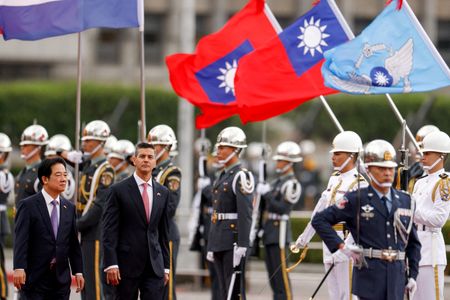
TAIPEI, Oct 13 (Reuters) – The Trump administration opposes “coercion and aggression” by China against countries for exercising their sovereign rights, the US State Department said, after Beijing sanctioned Belizean and Paraguayan ministers over their ties to Taiwan.
Paraguay and Belize are two of just 12 countries to maintain formal diplomatic relations with Taiwan. China says Taiwan is one of its provinces with no right to behave like a state, a view Taipei’s government strongly rejects.
The sanctions are largely symbolic because ministers from Taiwan’s diplomatic allies generally do not travel to China. Beijing has previously imposed similar measures mainly on Western politicians for their support of democratically governed Taiwan.
“The Trump Administration opposes coercion and aggression by China against countries in our hemisphere for exercising their sovereign rights,” State Department spokesperson Tommy Pigott said in a statement.
Pigott cited previous comments by Secretary of State Marco Rubio that the US “will not allow our region to become a base of operation for adversaries, competitors, and rivals to threaten our security or undermine our partnerships”.
“We stand with our friends and partners, including Taiwan, to advance our shared prosperity, security, and values,” Pigott added.
The United States is Taiwan’s most important international backer, despite the lack of formal diplomatic ties.
Washington has been concerned not only by Beijing’s efforts to win over Taiwan’s remaining allies, but also by attempts to increase its influence in Latin America.
TAIWAN’S VISIBILITY ‘GROWING HIGHER’
Speaking on Tuesday to reporters at parliament in Taipei, Taiwan Deputy Foreign Minister Chen Ming-chi said China was extending “transnational repression” to Taiwan’s allies.
“Taiwan’s international visibility is growing higher and higher, and they will be kept busy by this fact,” Chen said, referring to China. “Do they plan to sanction the whole world?”
Taiwan Premier Cho Jung-tai said Beijing had no right to interfere in the domestic affairs of, or influence the diplomacy of, any sovereign and independent state, “including the Republic of China”, referring to the island’s formal name.
“At the same time, we will resist any expansion of hegemony or authoritarianism,” he added, also speaking at parliament.
China has stepped up pressure on Taiwan’s remaining diplomatic allies to sever ties with Taipei.
The last country to do so was the tiny Pacific Island nation of Nauru, in 2024. Honduras ended its decades-long ties with Taiwan in 2023.
(Reporting by Ben Blanchard; Editing by Christopher Cushing, Saad Sayeed and Lincoln Feast.)
Brought to you by www.srnnews.com
 South Korea says US raises intelligence cooperation concerns, Yonhap says
 ASEAN to discuss tackling transboundary haze ahead of November summit
 IMF says AI investment propping up global growth, but war and debt threaten outlook
 ASEAN foreign ministers to tackle transboundary haze in November meetings