
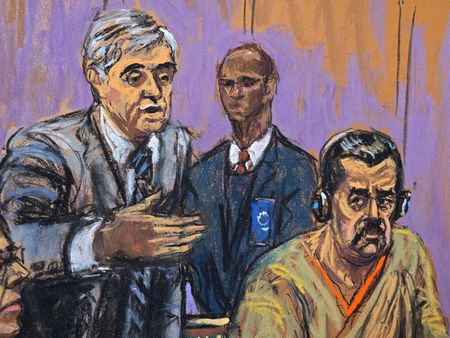
By Luc Cohen
April 25 – The United States has agreed to modify its sanctions on Venezuela to allow the South American country’s government to pay Nicolás Maduro’s defense lawyer, backing off a restriction that had threatened to derail the drug trafficking case against the ousted Venezuelan president, a court filing showed on Friday.
Maduro, 63, and his wife Cilia Flores, 69, were captured from their home in Caracas by U.S. special forces on January 3 and brought to New York to face criminal charges including narcoterrorism conspiracy. They have pleaded not guilty and are jailed in Brooklyn pending trial.
Maduro’s lawyer Barry Pollack in February asked Manhattan-based U.S. District Judge Alvin Hellerstein to dismiss the case because U.S. sanctions were preventing the Venezuelan government from paying his legal fees.
Pollack said that prohibition amounted to a violation of Maduro’s rights under the U.S. Constitution to the counsel of his choice.
Neither Maduro nor Flores can afford lawyers on their own, and the Venezuelan government is prepared to pay their fees, their lawyers have said.
All criminal defendants in the U.S. have constitutional rights regardless of whether they are U.S. citizens.
Hellerstein said in a March 26 court hearing that he did not intend to dismiss the case, but appeared skeptical that the government was justified in blocking the payments.
Prosecutor Kyle Wirshba said in court that the U.S. sanctions blocking the payments were based on legitimate national security and foreign policy interests. Wirshba also said that Hellerstein could not order the Treasury Department to modify its sanctions because the executive branch, not the judiciary, is in charge of foreign policy.
Hellerstein noted that the U.S. had relaxed sanctions on Venezuela since Maduro’s ouster. Relations between Caracas and Washington have improved since Delcy Rodriguez, Maduro’s former vice president, began leading Venezuela on an interim basis.
“The defendant is here, Flores is here. They present no further national security threat,” said Hellerstein, a judicial appointee of Democratic President Bill Clinton. “The right that’s implicated, paramount over other rights, is the right to constitutional counsel.”
During his first term in the White House, U.S. President Donald Trump ramped up sanctions on Venezuela over allegations that Maduro’s government was corrupt and undermining democratic institutions. Washington called Maduro’s 2018 reelection fraudulent.
Maduro dismissed those accusations, along with allegations of his participation in drug trafficking, as pretextual justifications for what he called a U.S. desire to seize control of the South American OPEC nation’s vast oil reserves.
(Reporting by Luc Cohen in New York; additional reporting by Rhea Rose Abraham in Bengaluru; Editing by Nia Williams)
Brought to you by www.srnnews.com
 Russian parliament speaker in North Korea to mark Pyongyang’s troop deployment in Ukraine war
 Gunfire and blasts rock Mali as attackers hit capital and other cities, residents say
 Ukrainian drone hits apartment building in Russian city of Yekaterinburg, local official says