
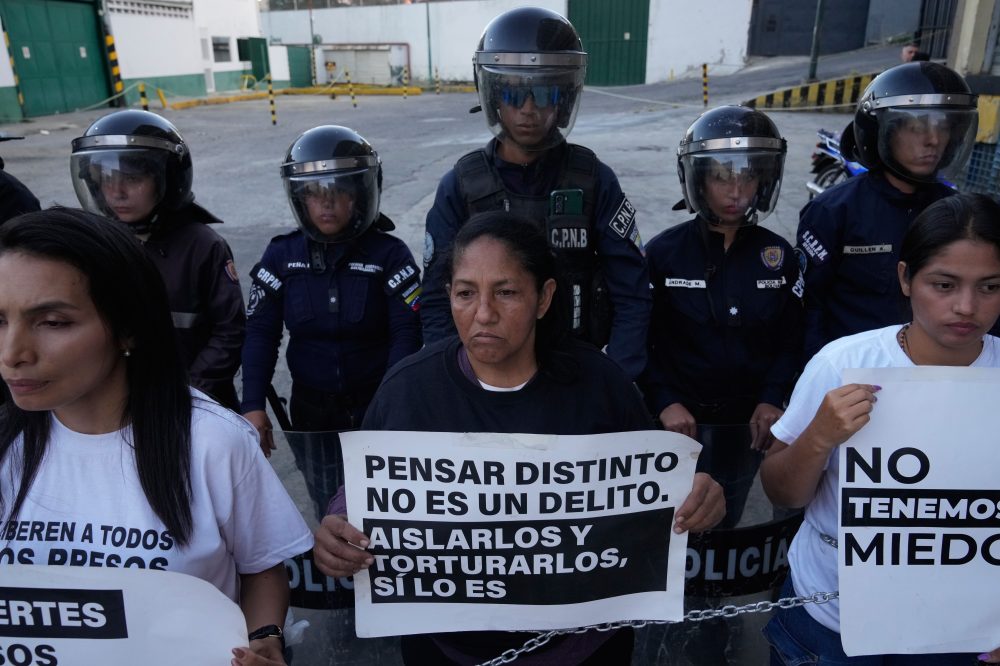
CARACAS, Venezuela (AP) — Regina Garcia Cano reported and wrote The Associated Press story that chronicled the efforts of two women to protest the Venezuelan government over the detentions of their husbands. Garcia Cano, along with video journalist Juan Arraez and photographer Ariana Cubillos, shadowed the women and as many as 30 others during their 64-day protest outside a police station in Venezuela’s capital, Caracas, where their husbands and loved ones were being held.
The protests tested the women’s health and resolve, as well as the Venezuelan government’s willingness to restrain its repressive impulses. Though the tent city outside the station was taken down and the women went home, the journey of the two wives has not ended — they are still trying to find ways to free their husbands.
This is an interview of Garcia Cano by Del Quentin Wilber, who edited the story.
The Trump administration stunned Venezuelans when it backed a ruling-party loyalist, not the political opposition, to lead the South American country after the U.S. military in January deposed then-President Nicolás Maduro. The government of acting President Delcy Rodríguez quickly released all U.S. citizens in its prisons. But it did not free hundreds of Venezuelans whom human rights groups contend are being held on political grounds.
Five days after Maduro was captured, the government announced it would release a significant number of prisoners, and weeks later, Rodríguez signed into law an amnesty measure that could benefit thousands of dissidents and opposition figures previously or currently detained.
That’s when dozens of women, mostly the wives and mothers of those being detained, began gathering outside police stations, jails and prisons expecting to see their loved ones walk free. But they did not. Scores of women refused to leave and began camping out in front of those same detention facilities to put pressure on the Venezuelan government.
These sit-in protests were unimaginable before Jan. 3. Venezuela’s government had made clear up until then that it had no tolerance for dissent. That was especially true in the aftermath of the 2024 presidential election, which Maduro claimed to have won despite ample credible evidence to the contrary.
More than 2,000 people were detained after the election, many without having protested at all. People grew scared and went quiet.
The women are the first Venezuelans to challenge the ruling party in the post-Maduro era. The mostly shy housewives had never protested. They put aside their fears, defied the advice of friends and family to keep quiet and risked arrest to stand up to the government. And for the most part, they succeeded.
Video journalist Juan Arraez and I interviewed many women protesting outside detention facilities. He even slept a few times at the camp where Mendoza and Rosales lived.
We focused on Mendoza and Rosales because both spent significant time camping outside a jail, leaving their children and lives behind. They were strangers and became friends through their shared struggle.
In addition, their families represent two distinct but very common life stories in Venezuela. In Rosales’s case, the wife and husband work for the state, support the ruling party and live in a once-thriving community. Meanwhile, Mendoza and her husband were apolitical and depended mostly on one private sector income.
This was a story about protest — but also about deep female friendships.
It was really special to see the women and their relationships deepen. They went from shy, quiet and suspicious strangers to chatty, candid and supportive friends. Together, they learned to protest, use a megaphone, advocate to lawmakers and even navigate jail rules. They held each other when they needed to cry and cheered the others’ victories. They talked through fears, love, parenting and doubts.
___
Follow AP’s coverage of Latin America and the Caribbean at https://apnews.com/hub/latin-america
Brought to you by www.srnnews.com
 Lebanon resident recognizes family crucifix smashed by Israeli soldier in viral image
 After last year’s fighting with Thailand, Cambodia readies new conscription law for men aged 18-25
 Kosovo court sentences 3 ethnic Serbs to life, 30 years in prison over 2023 clash