
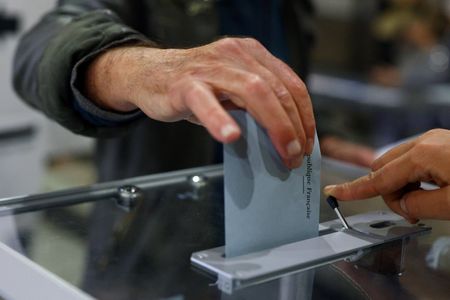
PARIS, March 23 (Reuters) – France held the runoff of mayoral elections on Sunday, and although the results of local contests do not always offer a reliable preview of national elections, the vote provided a snapshot of the political mood on the ground.
Here are five takeaways from the ballot, which comes 13 months before the next presidential elections, in April and May 2027:
THE RN’S MARCH TO POWER IS NOT UNSTOPPABLE
Marseille is no bellwether for France as a whole, yet the far right’s failure to capture the country’s second‑largest city, coupled with defeat in nearby Toulon, has punctured the sense of an unstoppable National Rally (RN) advance towards power in 2027.
The dominant assumption heading into the presidential race has been that RN leader Jordan Bardella stood as the clear favourite after two unpopular mandates under President Emmanuel Macron weakened the centrist camp.
The local results complicate that picture.
They suggest that mainstream parties, when organised, can still block the RN, particularly in large cities where the party’s brand remains toxic for many voters.
However, the RN’s advance has not stalled everywhere.
In fiercely conservative Nice, RN ally Eric Ciotti defeated a Macron‑backed candidate. The party also picked up smaller cities such as Carcassonne and multiplied its number of councillors thirteen‑fold.
Bottom line for 2027: the RN remains the frontrunner on paper, but the sense of inevitability has weakened, and its ceiling in big cities still looks real.
THE CENTRE BEATS LOW EXPECTATIONS – AND MAY UNITE
The centrist camp did better than expected despite Macron’s personal unpopularity.
Former Prime Minister Edouard Philippe held Le Havre, defying polls and reinforcing his status as the centrist best placed to take on the RN in 2027.
Macronist candidates also notched unexpected victories in Bordeaux and Annecy, and gained influence through alliances in Toulouse, Angers and Limoges.
The picture remains mixed, however. Macron‑backed candidates lost in Lyon, Nice and Pau, where former Prime Minister François Bayrou was unseated.
Bottom line for 2027: Philippe has emerged as the centre’s most credible contender, but without unity behind him the bloc still risks missing the second round.
ALLIANCES WITH LFI REMAIN A LIABILITY FOR THE LEFT
The elections sent a clear signal to the mainstream left: it performs better without the hard-left France Unbowed (LFI).
LFI has been weighed down by controversy, from the fallout of the killing of a far‑right activist in Lyon to renewed accusations of antisemitism linked to remarks by Jean‑Luc Mélenchon.
In Paris, Socialist Emmanuel Grégoire won after refusing a deal with LFI. In Marseille, Socialist Benoît Payan defeated the RN while keeping his distance from LFI, whose candidate withdrew.
By contrast, Socialist‑LFI alliances were defeated in cities including Toulouse, Limoges and Clermont‑Ferrand. LFI still scored symbolic victories in Saint‑Denis and Roubaix, showing it retains a mobilised base, but one with limited reach.
Bottom line for 2027: the left is heading toward a strategic reckoning, with the presidential race likely to pit two competing visions of the left against each other.
LYON BELIES FADING GREEN MOMENTUM
The Greens, who surged to power in major cities in 2020, failed to repeat that success.
After a cost‑of‑living crisis and geopolitical instability, environmental issues appear to have slipped down voters’ priority lists. Green mayors lost in Strasbourg, Bordeaux and Poitiers.
In Lyon, the outgoing Green mayor narrowly held on, highlighting how fragile the party’s urban strongholds have become.
Bottom line for 2027: the Greens’ retreat reflects a backlash against priorities and messaging that struggled to resonate beyond their core base, raising doubts about their leverage in 2027.
THE CONSERVATIVES’ LOCAL STRENGTH HAS LIMITS
The conservative Republicans (LR) failed to conquer Paris, a symbolic defeat widely attributed to the polarising profile of candidate Rachida Dati and her looming corruption case.
Elsewhere, the party stressed its resilience, remaining France’s biggest local force.
Bottom line for 2027: the Republicans retain a solid electoral base, but they still need to decide whether they prefer to be a well-supported minority or whether they should unite with the centre to take on extreme parties on the left and right.
(Reporting by Michel Rose; Editing by Chris Reese)
Brought to you by www.srnnews.com
 Vehicles belonging to Jewish ambulance service set on fire in London in apparent antisemitic attack
 50 years after Argentina’s bloody coup, families still search for and bury the disappeared
 International Energy Agency head says global economy faces ‘major, major threat’ because of Iran war