
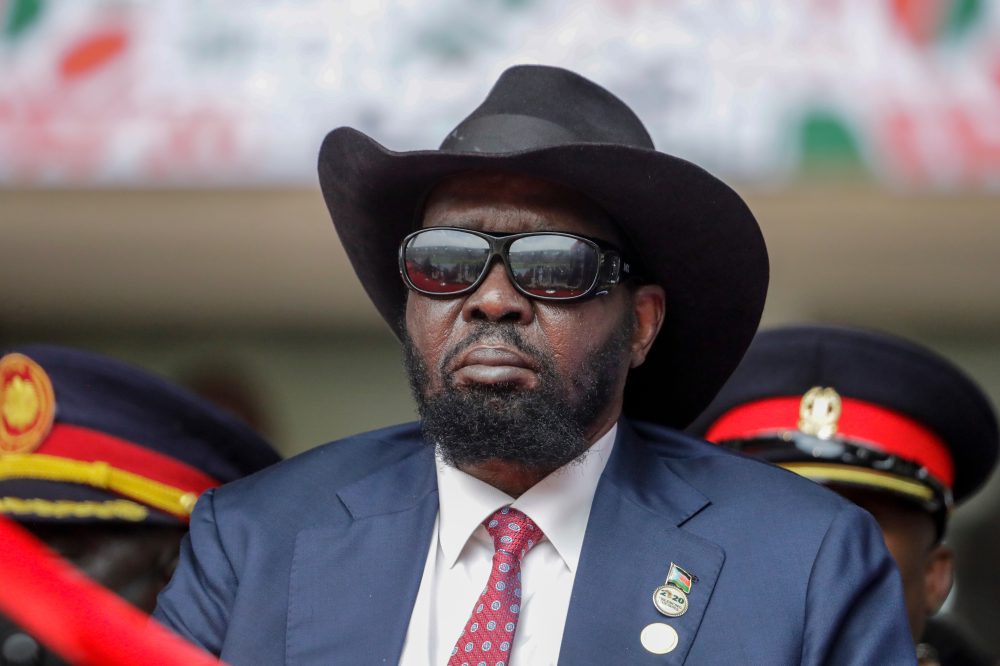
NAIROBI, Kenya (AP) — South Sudan’s army, following territorial losses in recent weeks, has announced a major military operation against opposition forces, raising fears for civilian safety.
In a statement on Sunday, army spokesman Lul Ruai Koang said Operation Enduring Peace would commence and ordered civilians to evacuate three counties in Jonglei state immediately. He directed aid groups to leave within 48 hours.
Koang told The Associated Press on Monday that the operation aims to recapture towns recently seized by opposition forces and “reestablish law and order.”
The announcement came a day after a senior army commander was filmed urging his troops to kill civilians and destroy property in the Jonglei offensive, drawing rebuke from the U.N. and others.
“It is now indisputable: South Sudan has returned to war,” said Alan Boswell of the International Crisis Group. “It is incredibly tragic for a country that only grows weaker and poorer.”
Here’s what to know about the conflict in South Sudan:
Beginning in December, a coalition of opposition forces seized a string of government outposts in central Jonglei, a region that is the homeland of the Nuer ethnic group and an opposition stronghold.
Some of those forces are loyal to opposition leader Riek Machar, while others consider themselves part of an ethnic Nuer militia called the White Army. White Army fighters have historically fought alongside Machar but consider themselves a distinct group.
Machar, an ethnic Nuer, was made the most senior of five vice presidents under a 2018 peace agreement that ended fighting between his forces and those loyal to President Salva Kiir, an ethnic Dinka, the country’s largest group. That five-year civil war was waged largely along ethnic lines, killing an estimated 400,000 people.
But there has been a resurgence of violence in the past year, with sporadic fighting.
Machar was suspended last year as South Sudan’s No. 2 after White Army fighters overran a military garrison in the town of Nasir. He now faces treason and other charges over that attack, which authorities allege Machar helped orchestrate. But Machar’s allies and some international observers say the charges are politically motivated. He remains under house arrest while his trial unfolds slowly in the capital, Juba.
Machar’s trial is widely seen as a violation of the 2018 peace agreement. Yet Kiir and his allies say the agreement is still being implemented, pointing to a faction of the opposition still in the unity government.
Forces loyal to Machar have declared the agreement dead, and have since ratcheted up pressure on the army by seizing armories and launching hit-and-run attacks on government positions. The government has relied largely on aerial bombardments to beat back a rebellion that analysts say is gaining momentum across multiple states.
After seizing the government outpost of Pajut in Jonglei on Jan. 16, opposition forces threatened to advance toward Juba. The government has responded by amassing fighters in nearby Poktap, while several thousand Ugandan soldiers defend Juba.
Army chief Paul Nang gave his troops one week to “crush the rebellion” in Jonglei.
On Saturday, a day before the army announced its offensive, a senior military commander was filmed urging his forces to kill all civilians and destroy property during operations in Jonglei. It was not clear who took the video, which has been shared on social media.
“Spare no lives,” Gen. Johnson Olony told forces in Duk county, not far from Pajut. “When we arrive there, don’t spare an elderly, don’t spare a chicken, don’t spare a house or anything.”
Armed groups in South Sudan, including the military, have repeatedly been implicated in civilian abuses, including sexual violence and forced recruitment.
Olony’s comments were particularly aggressive, and drew concern. “We are shocked, we are disturbed, we are surprised,” said Edmund Yakani, a prominent civic leader.
Olony’s words showed that government troops were being “empowered to commit atrocities, to commit crimes against humanity, and, potentially, even to commit a genocide,” he said.
The U.N. Commission on Human Rights in South Sudan expressed “grave alarm” at developments that it said “significantly heighten the risk of mass violence against civilians.”
Machar’s political group said in a statement that Olony’s words were an “early indicator of genocidal intent.”
Speaking to the AP, government spokesman Ateny Wek Ateny called Olony’s comments “uncalled for” and “a slip of the tongue.”
But he also said that while it was possible Olony was “trying to boost the morale of his forces,” his words are not indicative of government policy.
Olony, appointed assistant chief of defense forces for mobilization and disarmament a year ago, also leads a militia, known as the Agwelek, from his Shilluk tribe that agreed to integrate into the army last year.
Olony’s deployment to Nuer communities is contentious because of a separate rivalry between the Shilluk and Nuer communities. In 2022, White Army fighters razed Shilluk villages and displaced thousands of civilians before the government intervened with attack helicopters.
Olony’s forces were also involved in military operations in other Nuer communities last year.
Deploying him to Jonglei “is incendiary,” said Joshua Craze, an independent analyst and writer on South Sudan. “His presence in the state is a propaganda gift to the opposition in its mobilization efforts.”
Brought to you by www.srnnews.com
 India says it has contained Nipah virus outbreak as some Asian countries ramp up health screenings
 The EU is seeking new trade partnerships. Here’s why
 A private plane crashes in western India and kills a deputy chief minister and 4 others
 Britain’s Starmer heads to China as Western alliances face strain