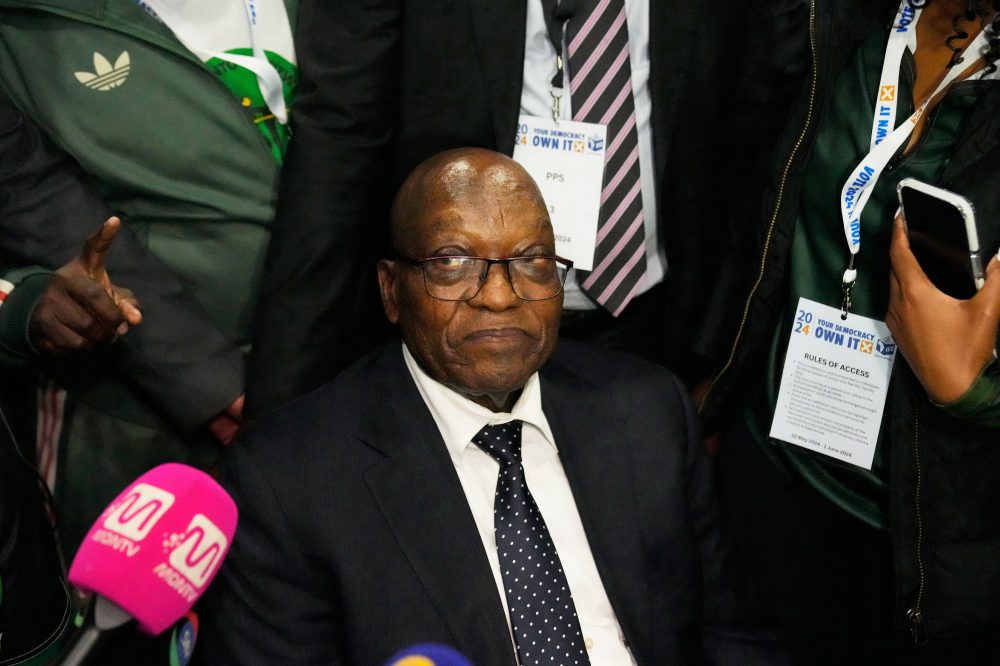
JOHANNESBURG (AP) — Former South African President Jacob Zuma and his co-accused, the French arms manufacturer Thales, returned to court on Thursday to appeal for the dismissal of the long-running corruption case against them.
Zuma, one of the key figures of the South African liberation struggle who served as president from 2008 to 2018, is accused of corruption in connection with an arms transaction in 1999.
Here’s what to know about the case:
Zuma faces 18 charges, including corruption, fraud, and money laundering, linked to 783 alleged illegal payments he received from French armaments manufacturer Thales (formerly Thomson-CSF) and business owner Schabir Shaik.
Zuma has refuted every indictment, saying the accusations are part of a “witch hunt” with political motivations. He is currently fighting to have the charges dropped after entering a not guilty plea.
The case has been ongoing for nearly two decades, facing multiple delays including legal challenges by Zuma’s team, which has repeatedly appealed and challenged the charges.
In a potentially groundbreaking development, the National Prosecuting Authority is arguing before Judge Nkosinathi Emmanuel Chili this week that Zuma and Thales should be blocked from using its appeals to further delay their trial.
“Our problem is that this strategy has delayed the case for 18 years,” advocate Trengrove told the court on Thursday. “Mr. Zuma has over the years run 8 different interlocutory applications and Thales has been part of four. They have between them delayed the hearing for more than 18 years, all those applications have been dismissed.”
The ex-president’s lawyers have also questioned the lead prosecutor Advocate Billy Downer’s impartiality, leading to additional delays. The former president’s ill health has further stalled the case.
Zuma’s defense attorneys have also contended that without the testimony of two crucial Thales executives in the case —former directors Pierre Moynot and Alain Thetard, who died in 2020 and 2022 —they won’t be able to mount a meaningful defense.
Zuma was found in contempt of court by the South African Constitutional Court on June 29, 2021. He received a 15-month prison sentence for refusing to testify before the Zondo committee, a judicial commission investigating allegations of corruption.
Zuma surrendered himself to the police on July 7, 2021, and was taken to the Estcourt Correctional Center in KwaZulu-Natal. He was then released on medical parole, but the parole was ruled to be unlawful, and he was ordered to go back to prison. However, he was later released from prison after his sentence was commuted.
In October the former president was ordered to pay back $1.6 million (R28.9 million) in legal fees that were unlawfully funded by the state for his personal corruption defense. The Gauteng High Court in Pretoria ruled that Zuma must also pay interest on the amount, calculated at the prescribed rate.
Zuma has since been attempting to appeal the judgment for legal fees, claiming he’s not liable.
____
AP’s Africa coverage at: https://apnews.com/hub/africa
Brought to you by www.srnnews.com
 The last hostage held in Gaza died fighting to save a kibbutz
 As Trump hosts Congo and Rwanda’s leaders for peace deal, here’s what to know about the conflict
 Luxury fashion firms asked for documents as part of Italian labor abuse probe