
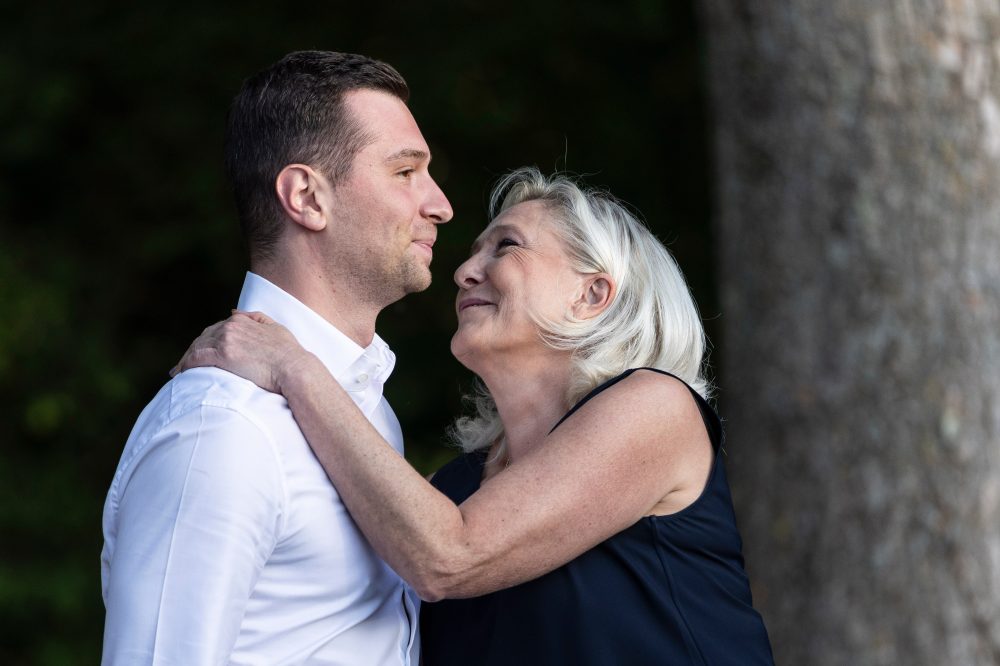
PARIS (AP) — If a French appeals court on Tuesday prevents Marine Le Pen from making what would be her fourth and likely strongest tilt for the country’s presidency, she has groomed a replacement who has already started to try on her mantle for size.
But Jordan Bardella is no carbon copy of the anti-immigration, populist leader who got closer than ever to taking the reins of Europe’s largest country in the last of her three previous presidential campaigns and has steered her party’s growth in popularity.
The most obvious difference and possibly the most important is that Bardella isn’t called Le Pen.
That name is anathema for a large number of French voters, particularly on the left, because Marine Le Pen inherited it — and the party that he founded — from her father Jean-Marie Le Pen. His opponents loathed his far-right politics and multiple law-breaking outrages, including Holocaust denial.
If the appeals court ruling on Tuesday bars Le Pen from next year’s election to replace two-term President Emmanuel Macron, who constitutionally cannot stand again, or prompts her to step aside for Bardella, then voters will assess how the two National Rally figures compare.
Here’s a more detailed look at differences and similarities between Le Pen, the mentor, and Bardella, the acolyte who’s been working to become more of his own man:
Bardella is the president of Le Pen’s National Rally, which was called the National Front when Jean-Marie Le Pen founded it in 1972.
As party president, Bardella has vigorously championed its anti-immigration platform, speaking of a France that he says is being overwhelmed by immigration from Africa in particular and with “many people who today no longer recognize the France that they loved.”
Bardella has adopted a more business-friendly tone in efforts to broaden the party’s appeal among entrepreneurs and wealthy conservative voters, while Le Pen traditionally focuses on purchasing power and state intervention, themes that resonate more with working-class voters.
Le Pen handed over the party leadership to Bardella in 2022, after she’d rebranded the party and worked for years to make it more palatable for voters. She did that by shifting away from her father, eventually kicking him out of the party entirely. She also retreated from some of her most divisive proposed policies for France, including that it withdraw from the European Union and restore the franc as its official currency, instead of the shared euro.
It’s been the National Rally since 2018 and the largest single party in parliament’s National Assembly since 2024.
Not having the baggage that comes with the Le Pen name could be an asset for Bardella, says Luc Rouban, a senior researcher at Paris’ Sciences Po school of political sciences who studies the party. “Symbolically, it would signal a break with the legacy of the old National Front, of Jean-Marie Le Pen.”
That heritage has been a vulnerability for Le Pen, with critics and historians never allowing her to forget her polarizing father’s associations with people who collaborated with France’s Nazi occupiers in World II and his hate-speech convictions.
In an election campaign, that mud might not stick so well on Bardella, the party’s first leader not called Le Pen.
“Jean-Marie Le Pen’s legacy is a very heavy burden to carry,” Rouban said. “If you move beyond the Le Pen family, you’re entering different territory.”
Le Pen, 57, says that 30-year-old Bardella’s age is a plus. “We are complementary,” she said in a recent interview. “I have a certain experience, but Jordan has an absolutely incredible dynamism; he has the strength and energy of his youth.”
Bardella leverages social media more effectively, with nearly double her following on Instagram and his 2.3 million TikTok followers outpacing Le Pen’s 1.5 million.
He might be better equipped than she is to mobilize Gen Z. Voters aged 18 to 29 have increasingly disengaged from national elections through the last five presidential cycles. According to France’s national statistics agency, only 17% of them cast ballots in all elections in 2022, when Macron beat Le Pen in the presidential knockout round for a second time. That’s sharply down from 31% who voted systematically in 2002.
Le Pen was born into politics. Her father served as a lawmaker from 1956 to 1962, before the birth of his youngest daughter in 1968, a year roiled by protests and strikes, with barricades on Paris streets. She joined the National Front as a teenager. After getting a law degree, Le Pen first stood as an FN candidate at just 24 years old for legislative elections in 1993.
Bardella has cut his teeth as a lawmaker in the European Parliament but he lacks her breadth of experience. Some analysts say that could make it harder for him to woo older voters.
His opponents and some experts speculate that Bardella could falter in the rough and tumble of what would be his first presidential election campaign.
But Victor Mallet, author of “Far-Right France: Le Pen, Bardella and the Future of Europe,” suggests that National Rally opponents shouldn’t be too sure of that.
“A lot of people thought the same thing about Donald Trump,” he said. “They thought, you know, this guy has no experience of government, his policies don’t make any sense, and he was elected twice.”
___
Associated Press journalists Sylvie Corbet and Jeffrey Schaeffer in Paris contributed to this report.
Brought to you by www.srnnews.com
 Gold rings around 2,000 years old found during dig at Thailand archaeological site
 Anissa Helou’s new book of recipes from Lebanon spotlights villages scarred by war
 As East Africa’s oceans change, coastal women build new livelihoods
 Factbox-NATO Ankara summit: who’s going and what to expect