
By Menna AlaaElDin, Nayera Abdallah and Humeyra Pamuk
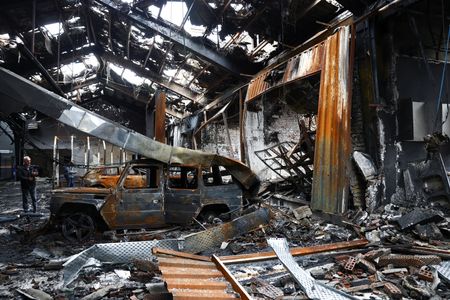
CAIRO/DUBAI, March 28 (Reuters) – Yemen’s Iran-aligned Houthis launched missiles at Israel on Saturday, their first such attack since the start of the Iran war, heightening the risk that a conflict now in its fifth week could expand further across the region.
Speaking before the strike, Secretary of State Marco Rubio said the United States expected to conclude military operations within weeks. The Houthis said they would continue their operations until the “aggression” on all fronts ended.
Iranian President Masoud Pezeshkian spoke to Pakistan’s prime minister, Shehbaz Sharif, whose government hosts a meeting with the Turkish and Saudi foreign ministers on Sunday to seek to ease regional tensions.
But there was no sign of an immediate diplomatic breakthrough in a war that has spread across the Middle East, killing thousands and hitting the world economy with the biggest-ever disruption to global energy supplies.
Israel said it had struck more than 100 targets in Iran since Friday, including ballistic missile production and storage facilities and government infrastructure sites in Tehran.
Iranian state media reported nine people killed in the western city of Borujerd and five killed in Zanjan in the northwest, saying both attacks were on residential areas.
Israel also said it had hit over 170 targets in Lebanon, where it has resumed its conflict against Iran-backed Hezbollah. Three Lebanese journalists were killed in a strike on a media vehicle, Lebanon’s Al Manar TV reported, and a Lebanese soldier also died.
Iran kept up attacks on Israel and several Gulf states after hitting an air base in Saudi Arabia on Friday and wounding 12 U.S. military personnel, two of them seriously, in one of the most serious breaches of U.S. air defences so far.
Drones damaged the radar system at Kuwait’s International Airport, and fires were reported near the Khalifa container port in the United Arab Emirates’ capital Abu Dhabi after a missile was intercepted. In Israel, seven people were hospitalised after an Iranian missile hit the village of Eshtaol, near Jerusalem.
HOUTHIS MAY POSE NEW THREAT TO GLOBAL SHIPPING
Israel, which regularly faced missile attacks from the Houthis before the war, confirmed a missile had been fired at it from Yemen. There were no reports of casualties or damage.
The attack pointed to a potential new threat to global shipping, already hit by the effective closure of the Strait of Hormuz, the conduit for about a fifth of global oil and liquefied natural gas supplies.
The Houthis have shown an ability to strike targets far beyond Yemen and disrupt shipping lanes around the Arabian Peninsula and the Red Sea, as they did in support of Hamas in the Gaza war.
If the Houthis open a new front in the conflict, one target could be the Bab al-Mandab Strait off the coast of Yemen, a chokepoint for sea traffic towards the Suez Canal.
With midterm elections due in November, the increasingly unpopular conflict, launched with U.S. and Israeli strikes on Iran on February 28, has weighed on President Donald Trump’s Republican Party. He has appeared eager to end it soon, while also threatening escalation.
Demonstrators took to city streets across the U.S. on Saturday in the third set of “No Kings” rallies, described by organizers as a call to action against the war.
Rubio said on Friday that military operations were expected to be concluded in “weeks, not months” and echoed Trump’s calls on European and Asian countries to help secure free passage through the Strait of Hormuz.
U.S. allies have been reluctant to be drawn into a war which could escalate if Trump decides to deploy ground troops to try to open the strait.
Rubio said the U.S. could achieve its aims without ground troops but acknowledged it was deploying some to the region “to give the president maximum optionality and maximum opportunity to adjust the contingencies, should they emerge”.
Washington has dispatched two contingents of thousands of Marines to the region, the first of which arrived on Friday on a huge amphibious assault ship, the U.S. military said in a social media post on Saturday. The Pentagon is also expected to deploy thousands of elite airborne soldiers.
MORE STRIKES WHILE TRUMP SPEAKS OF NEGOTIATIONS
Financial markets have reacted with alarm at signs the war may drag on.
The Brent crude oil benchmark is up more than 50% since the war began and in the U.S., where Trump is politically vulnerable to rising fuel prices, diesel in California hit a record average high, the American Automobile Association said.
Trump has threatened to hit Iranian power stations and other energy infrastructure if Iran does not open the Strait of Hormuz. But he has extended a deadline he had imposed for this week, giving Iran another 10 days to respond.
Israel has targeted Iran’s nuclear infrastructure, and the head of Russia’s state nuclear corporation Rosatom, which has evacuated staff from the Bushehr nuclear power plant on the Gulf coast, said the attacks threatened nuclear safety.
Pezeshkian said Iran would “retaliate strongly if our infrastructure or economic centers are targeted”.
“To the countries of the region: If you want development and security, don’t let our enemies run the war from your lands,” he said.
Pakistan, Egypt and Turkey have relayed messages between the warring sides although Tehran has said it has not been negotiating with Washington. Two people familiar with the back-channel efforts expressed doubt that direct talks would take place soon.
(Reporting by Reuters bureaux; Writing by Lincoln Feast, James Mackenzie, Timothy Heritage; Editing by William Mallard, Edwina Gibbs, Keith Weir and Philippa Fletcher)
Brought to you by www.srnnews.com
 The Media Line: 12 US Troops Injured, 2 Seriously, After Iranian Missiles and Drones Attack Military Base in Saudi Arabia
 Republic of Congo constitutional court confirms leader Sassou-N’Guesso’s election win and fifth term
 Don’t strike a deal with Iran’s current leaders, opposition figure Pahlavi warns
 Nestlé says 413,793 KitKat candy bars stolen en route from Italy to Poland