
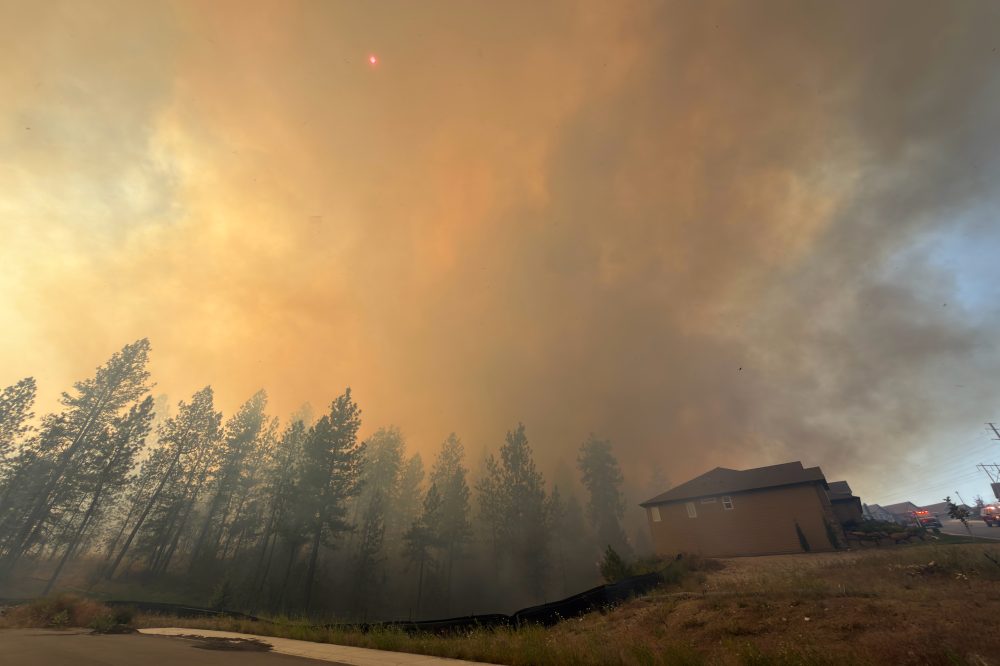
SPOKANE, Wash. (AP) — High winds drove a wildfire into an eastern Washington neighborhood, forcing the evacuation of about 1,500 people and destroying some homes, fire officials said Wednesday.
It’s unclear how many homes were lost in Spokane. Fire officials were working Wednesday to determine the number and the full extent of the damage, said Matthew Vinci, fire chief for Spokane County Fire District 9. He confirmed Tuesday that some homes were engulfed in flames.
The evacuation order for the 1,500 residents remained in effect Wednesday, said Chandra Fox, deputy director for Spokane County Emergency Management.
“Our concern is for increased winds Wednesday afternoon,” Fox said.
The blaze started just after noon on Tuesday and quickly moved up a hill, said fire district spokesman Robert Gray. Winds then shifted, sending flames into a neighborhood, Gray said.
Fire crews from Washington state and Idaho attacked the fire from the ground and air, but it quickly grew to 225 acres (.35 square miles). It was 10% contained Wednesday morning, according to the National Interagency Fire Center.
More than 32,000 fires have burned more than 3,900 square miles (10,100 square kilometers) so far this year in the United States, according to the fire center, which coordinates the mobilization of large-scale firefighting efforts.
That’s significantly higher than the 10-year average of just under 24,000 fires burning about 2,200 square miles (5,700 square kilometers) by early June, according to the fire center, even though fire activity has been relatively light in recent weeks.
Weather and fuel models that predict conditions like wind, lightning and how likely plants and other materials are to burn also show an increased danger of fires in multiple areas across the U.S. in coming weeks, according to NIFC. Some regions with critical conditions for fire include portions of California, and the Southwest, Great Basin and Rocky Mountain areas.
Brought to you by www.srnnews.com
 US is interested in a Polish offer for a permanent US military base, Polish official says
 Senior US officials dictate memorandum with Iran to journalists
 Military officials identify all 8 victims of fiery B-52 crash at California Air Force base
 Trump administration to buy back another energy company’s offshore wind leases for 4 more projects