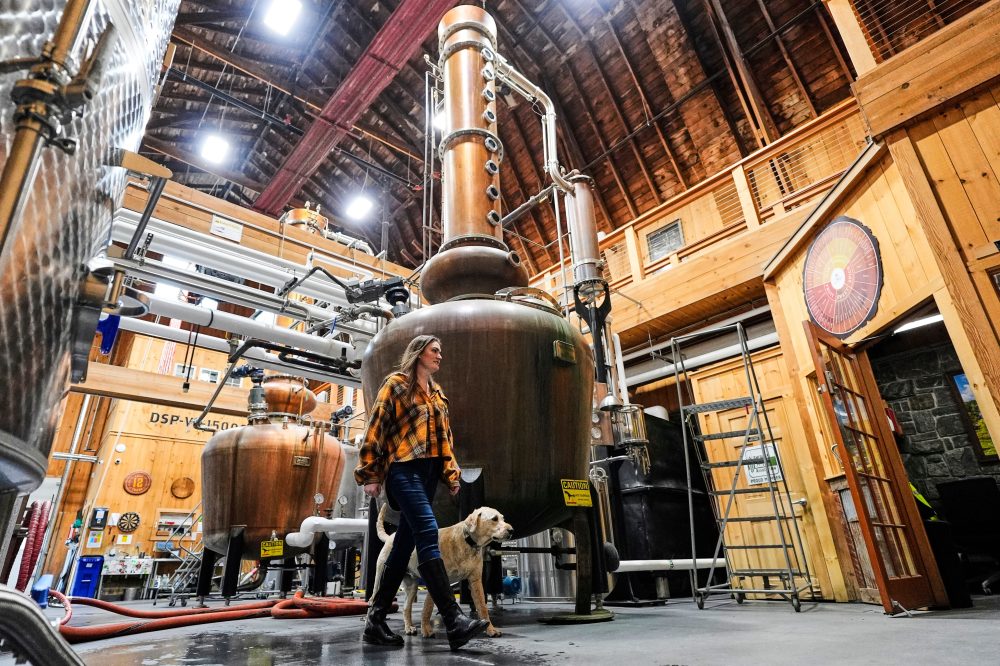
SHOREHAM, Vt. (AP) — Meghan Ireland always loved chemistry, but as a college freshman studying chemical engineering, she didn’t know she could channel her passion for science into the art of making whiskey.
It took stumbling across an article about a female chemical engineer who became a master whiskey distiller for something to click: Ireland’s fellow students could go into plastics and pharmaceuticals, she was going into whiskey.
“It was kind of like a connection of, ‘hey, I can see someone who looks like me, who has the same exact kind of education and background doing this job,’ and kind of opened it up as an option,” said Ireland, now the chief blender behind Vermont-based whiskey brand WhistlePig.
Ireland is among a growing number of women who have become leaders inside a traditionally male-dominated industry that has not always welcomed outsiders. Increasingly, women are launching their own brands and finding new ways to innovate in distilling and blending at a time when more women are drinking whiskey.
There is a common, lingering doubt among some male colleagues and consumers that the women gaining expertise in the industry even like whiskey.
Becky Paskin, a journalist from the U.K. and founder of OurWhiskey Foundation, an organization that promotes and supports women in the whiskey business, said she was asked that question while serving as a judge at a whiskey tasting event.
“It is a drink that comes with certain expectations around which gender drinks it and which gender makes it,” Paskin said, adding: “Barely any other drink or food falls under such scrutiny,”
Paskin says part of her work is creating stock images of women consuming whiskey that don’t present women as sex objects and are not a public service warning.
“The only images of women drinking whiskey were depicting them as being pregnant, drunk, naked; or pregnant, drunk and naked,” she said.
Whiskey-making has long been considered a masculine profession in America, a drink exclusively enjoyed by men swirling golden liquid in dark, smoky rooms. But industry experts and historians are quick to point out that women have always been involved in the process and were likely key to its survival in the U.S.
The first distilling instrument was created by a woman, Maria Hebraea, an alchemist from around the 2nd century, according to Susan Reigler, a bourbon expert. From there, distilling was largely seen as women’s work as they were in charge of home brewing, making medicine and taking care of the home.
Women notably managed distilleries in the 1800s in Kentucky, where Catherine Carpenter recorded the first known recipe for sour mash, now the most common style of American whiskey. And while women led the temperance movement in the 19th and 20th centuries, some historians estimate there may have been more female bootleggers than men during Prohibition — in part because women were less likely to be searched by police, according to the book “Whiskey Women,” written by Fred Minnick.
Reigler says she often marvels at the U.S. whiskey industry’s transformation, which was in a serious downturn in the 1990s when she first began reporting on it from Louisville, Kentucky. As distillers worked to make whiskey appealing to American consumers, Reigler began documenting how women contributed to that effort, ranging from the wives who made key marketing decisions that boosted distillery tourism to the female bartenders who designed new whiskey cocktails.
Three women co-founded the Kentucky Bourbon Trail — a novel idea at the time that has since been copied across the country — including Peggy Noe Stevens, the world’s first female Master Bourbon Taster, who was working at Woodford Reserve, as well as Donna Nally with Maker’s Mark and Doris Calhoun with Jim Beam, Reigler said.
“There have always been women in bourbon,” she said. “But a lot of them have been behind the scenes.”
In Vermont, Ireland has been in charge of keeping WhistlePig’s whiskey consistent since 2018, but she also oversees experimental batches. Her first whiskey innovation was the Boss Hog VII that quickly attracted praise and awards for her decision to finish it in Spanish oak and Brazilian teakwood barrels.
Ireland says more women becoming involved in the industry establishes whiskey as “a drink for everyone.”
“It can be enjoyed by everyone and it’s being made by females too,” she said.
Judy Hollis Jones spent years as a senior executive in the food industry before launching a whiskey company in Kentucky in 2019. The transition to the whiskey world mimicked the boardrooms she had been in for decades, where she was often the only woman present.
Hollis Jones is the president and CEO of Buzzard’s Roost, a whiskey brand she co-founded with Master Blender Jason Brauner. She describes the whiskey industry as a “tough business” that has ebbed and flowed over the years, but one thing that has steadily increased is the amount of women showing up to tastings and tours, eager to take partake in the whiskey experience.
“I’ve had people say to me, ‘Oh, well, you don’t wear jeans, boots and a cowboy hat,’” she said. “And I said: ‘No, I don’t. And every bourbon drinker female does not. We are very wide range of people that love bourbon.’”
___
Associated Press reporter Dylan Lovan in Louisville, Kentucky, contributed.
Brought to you by www.srnnews.com
 Book bans and attempted bans remain at record highs, with ‘Sold’ topping the list
 Wildfire survivors who lost their homes could face another blow from taxes on settlement payouts
 What to know as ceasefire in the Iran war hangs in the balance