
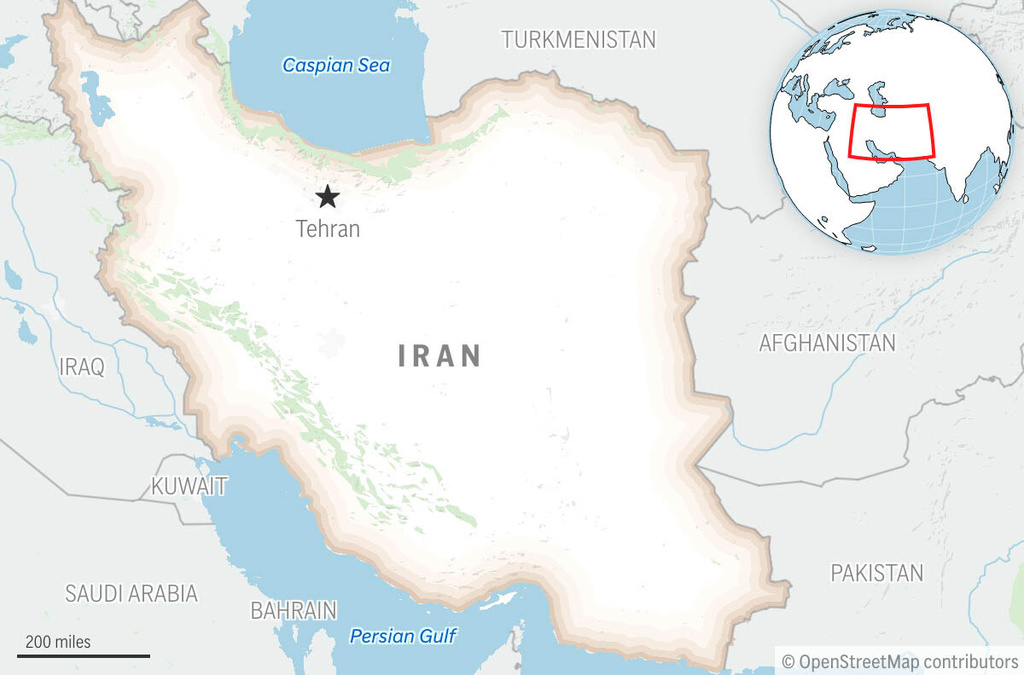
TEHRAN (AP) — Iran said Monday it is close to finalizing an agreement with Oman on a plan to manage shipping through the Strait of Hormuz, while President Donald Trump renewed threats against the Gulf nation and downplayed the expiration of a U.S.-Iran negotiating deadline.
Iranian Foreign Ministry spokesman Esmail Baghaei said Tehran and Muscat have reached “an understanding” on a transit route through the strategic waterway, with both sides working to finalize details for a joint statement.
“An understanding has been reached regarding the map of the transit route,” Baghaei told reporters in Tehran.
While he offered few specifics, previously reported details indicate ships would enter the strait along a route near Iran and exit along a route closer to Oman. Vessels would transit the waterway without fees or tolls during an interim period.
The Strait of Hormuz, through which roughly one-fifth of the world’s traded oil passed before the war, was effectively closed by Iran after attacks by Israel and the United States on Feb. 28.
The United States has pushed for an acceptable agreement to reopen the waterway before ending its blockade of Iranian ports.
Baghaei acknowledged negotiations with Oman have moved slowly but said Tehran still intends to complete the agreement as a package combining the transit map and a joint statement.
Meanwhile, Trump threatened military action against Oman if it interferes with efforts to reopen the shipping lane.
Speaking to Fox News correspondent Trey Yingst, Trump said the United States would bomb Oman if it “gets in the way,” according to the network. Fox did not air audio from the interview.
The president has previously threatened Oman. During a Cabinet meeting in May, Trump said, “Oman will behave just like everybody else, or we will have to blow them up.”
Trump also dismissed the significance of the expiration of a 60-day negotiating period aimed at securing a peace agreement between Washington and Tehran. According to Yingst, Trump said there was no fixed timeline and revealed the United States maintains a back channel for talks with Iran’s Islamic Revolutionary Guard Corps.
The diplomatic uncertainty comes as U.S. Middle East envoy Jared Kushner met with Israeli Prime Minister Benjamin Netanyahu over efforts to advance a Gaza ceasefire roadmap.
Kushner’s meeting followed two hours of talks in Egypt with Hamas leader Khalil al-Hayya focused on disarmament. Hamas says it has accepted a U.S.-backed, 15-point roadmap and is urging mediators and the U.S.-created Board of Peace to pressure Israel to sign on.
Netanyahu last week rejected the proposal, arguing Hamas must fully disarm before any Israeli withdrawal from Gaza. Under the plan, Israel would gradually pull back its forces from the territory, where Israeli troops currently control about 60% of the Gaza Strip.
Elsewhere, Iraqi officials reported a pair of drone attacks targeting government figures in the country’s semi-autonomous Kurdish region.
Regional counterterrorism officials said one drone targeted the office of Kurdish Prime Minister Masoud Barzani, while another was aimed at the home of a senior intelligence official. Authorities said the drones were launched from near the Iranian border.
No casualties were reported, and no group immediately claimed responsibility.
Barzani described the strikes on social media as “a dangerous escalation and a direct threat to the security and stability of the Kurdistan Region.”
The attacks occurred as U.S. forces stationed in northern Iraq continue withdrawing ahead of a Sept. 30 deadline agreed to by Washington and Baghdad for the end of the American military mission in Iraq.
Brought to you by www.srnnews.com
 Russian court jails a Kremlin critic for 11 years for opposing the war in Ukraine
 Congo’s fast-moving Ebola outbreak becomes the country’s worst with over 2,300 dead